

 Tech & Tools Desk
‘A Toaster with a Lens’: The Untold Story of the First Handheld Digital Camera
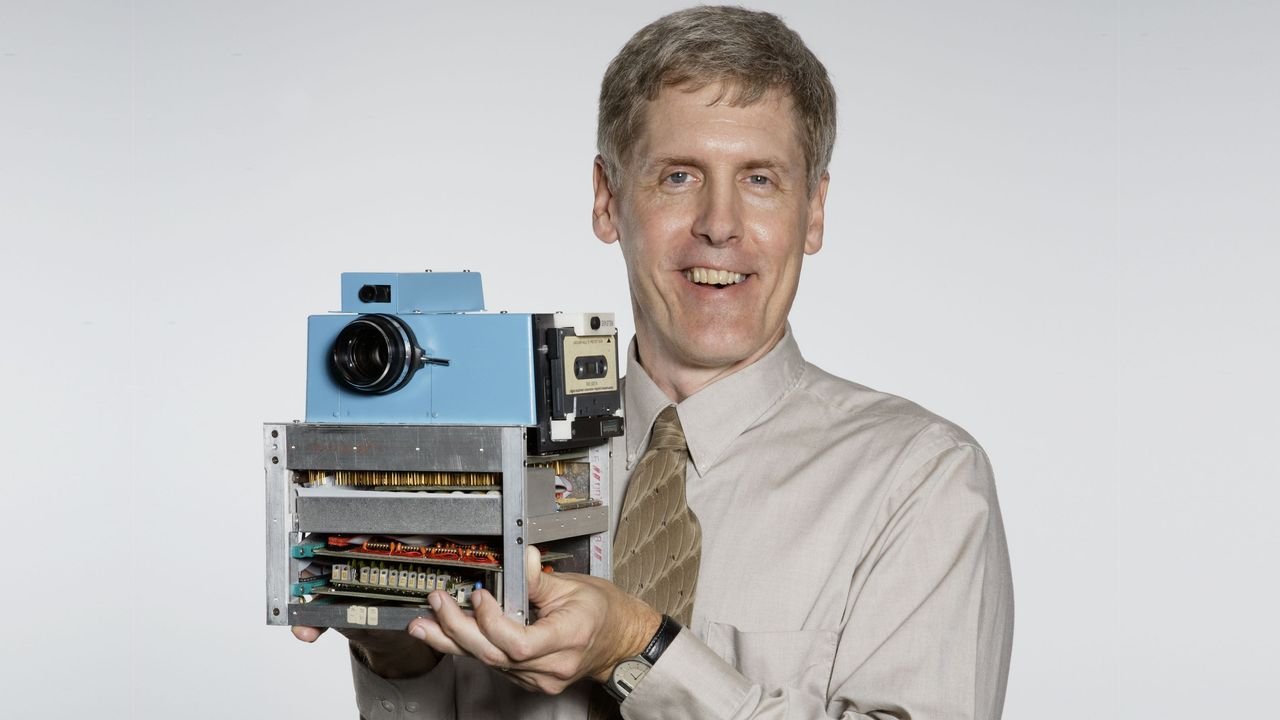
In 1975, a young engineer working inside Kodak took a photograph that would quietly change the world. That picture captured not on film but on a homemade electronic device marked the birth of the handheld digital camera and set photography on a path it could never return from.
When Steve Sasson joined Eastman Kodak in 1973, the company stood as a towering symbol of American industrial innovation. Founded in the 1870s by George Eastman, Kodak had become practically synonymous with photography itself. People bought Kodak film, placed it inside Kodak cameras, developed the negatives using Kodak chemicals, and viewed the results on Kodak photographic paper. The company had even captured this seamless process in a famous slogan: “You press the button, we do the rest.”
But Sasson, a newly hired electrical engineer, felt different from most of the people around him. He wasn’t trained as a chemist designing better films, and he wasn’t a mechanical expert crafting new camera bodies. He was fascinated by electronics and to him, the traditional photographic process felt slow, messy, and outdated.
“When you started at Kodak, you were required to take photography lessons,” Sasson, now 75, recalled during a video interview from his home office in the US. “You had to learn how to expose film, develop it, and handle chemicals. Honestly, I found it very frustrating. You’d take a picture and then wait forever to see it.”
Growing up watching Star Trek, Sasson imagined something better. “I kept thinking why not do everything electronically? Why not capture and store the image without any film at all?”
Although no one had set out to invent a digital camera, the underlying technology had been evolving for years. Scientists already knew that certain metals could generate tiny electrical currents when exposed to light. This principle had been used in early light meters, including selenium-based cells. NASA’s Landsat satellites were already capturing crude digital images from space, and astronomers were using large, expensive computers to convert telescope data into pictures.
The missing link arrived in 1969 when Bell Labs created the charge-coupled device (CCD), a special integrated circuit capable of storing and transferring electrical charges. While its inventors suspected it might one day help with imaging, they had not yet figured out how. By 1974, Fairchild Semiconductors had built the first commercial CCD a tiny, 100-by-100-pixel sensor. Still, no one had tried to use it to actually take and display a photograph.
That changed when Sasson’s supervisor, Gareth Lloyd, casually handed the project to him.
“I vividly remember him leaning on my filing cabinet and telling me, ‘I’ve got two small filler projects for you,’” Sasson said. One was related to modelling exposure systems for a movie camera. The second was simple: “Take a look at this new thing called a CCD.”
Sasson was immediately hooked. His academic background included experiments with light-sensitive semiconductors, and he believed he now had enough pieces to create something entirely new.
“I thought, all I need is a way to store a charge pattern from light an optical image,” he said. “It felt clean, elegant, and modern.”
With no official budget and no formal approval, Sasson began building in secret. He scavenged parts from around Kodak’s labs, including a lens assembly he found in a used-parts bin. He sourced an analogue-to-digital converter from a cheap digital voltmeter instead of an expensive specialist component.
“I basically stole everything,” he admitted. “Nobody had told me to build a camera.”
The early CCD chips were extremely difficult to work with, requiring as many as 12 different voltage supplies. The slightest mistake meant no output at all. Even when it worked, the chip had a major flaw: the image degraded almost immediately due to a phenomenon called “dark current,” now known as electronic noise.
Still, Sasson pushed on. He linked the sensor to a lens, created a system to convert light into digital data, and then faced a new challenge storage. With no modern memory options available, he used an audio cassette tape to store the raw digital information.
But capturing the image was only half the battle. He also had to show it.
So he built a separate playback system that converted the stored digital data into a signal a television could display. To do this, he needed a microprocessor technology that was still brand new and extremely expensive. He cleverly wrote a proposal asking for one under the pretext of “research.” To his surprise, it was approved.
Together with colleague Jim Schueckler, Sasson spent over a year assembling the ever-growing device. By the end of 1975, the machine was ready.
The camera was anything but elegant. It weighed about 8 pounds (3.6kg), was the size of a small appliance, and resembled a cobbled-together toaster more than a consumer product. But it worked.
Sasson carried it into a nearby office and asked coworker Joy Marshall if he could take her photograph. She agreed, somewhat amused by what she viewed as an eccentric experiment from “the weird guys down the hall.”
He pressed the shutter. The image was captured in 1/20th of a second, but took 23 seconds to record onto the cassette tape.
Back in the lab, he loaded the tape into the playback unit and connected it to a television. Slowly, a crude image formed on the screen.
Her head and hair were visible. Her shoulders appeared. But her face was badly distorted.
Despite the flaws, Sasson and Schueckler were ecstatic. The structure of the image was there. It worked.
Joy Marshall, standing in the doorway watching, simply said, “Needs work,” and walked away.
After adjusting the circuit which at the time meant physically reversing wires instead of rewriting software the image improved. A real, recognizable picture had been taken and displayed without a single piece of film.
This was the first handheld digital photograph in history.
Word soon reached Kodak management, and Sasson began demonstrating his invention to executives across the company. Each time, he repeated the same routine: photographing people in the room, recording the images, and then revealing them on a television.
“The moment the picture appeared, I lost control of the room every single time,” Sasson said. Managers were both amazed and confused.
Instead of asking how the device worked, they asked why it should exist at all. Why remove film? Why remove paper? What would people do with electronic pictures?
Someone eventually challenged him directly: why spend thousands of dollars on a device that produced worse pictures than a cheap film camera?
Sasson didn’t have an answer so he created one.
He calculated how long it might take for digital sensors to match film quality, basing his estimates loosely on Moore’s Law. His prediction: about 15 to 20 years.
He was nearly perfect. Kodak released its first consumer digital camera in 1995 – 18 years later.
In 1978, Kodak received the first-ever patent for a digital camera, listing Sasson as the inventor. That single patent would later earn the company billions through licensing.
Other engineers, like Bryce Bayer, would go on to create the colour-filter technology that made modern digital photography possible. Sasson himself continued working in digital imaging until he retired in 2009.
Years later, while sitting with his family at Yellowstone National Park in 1998, waiting for Old Faithful geyser to erupt, Sasson looked around and saw people lifting film cameras, video cameras, and for the first time digital cameras.
“That’s when it hit me,” he said. “It’s happening.”
His original camera now sits in a museum in Rochester, New York. What began as a borderline stolen-parts experiment in a quiet Kodak lab became the foundation of how the world captures its memories today.