

 Lifestyle & Wellness Desk
China Passes ‘Ethnic Unity’ Law Mandating Mandarin Learning for Minorities
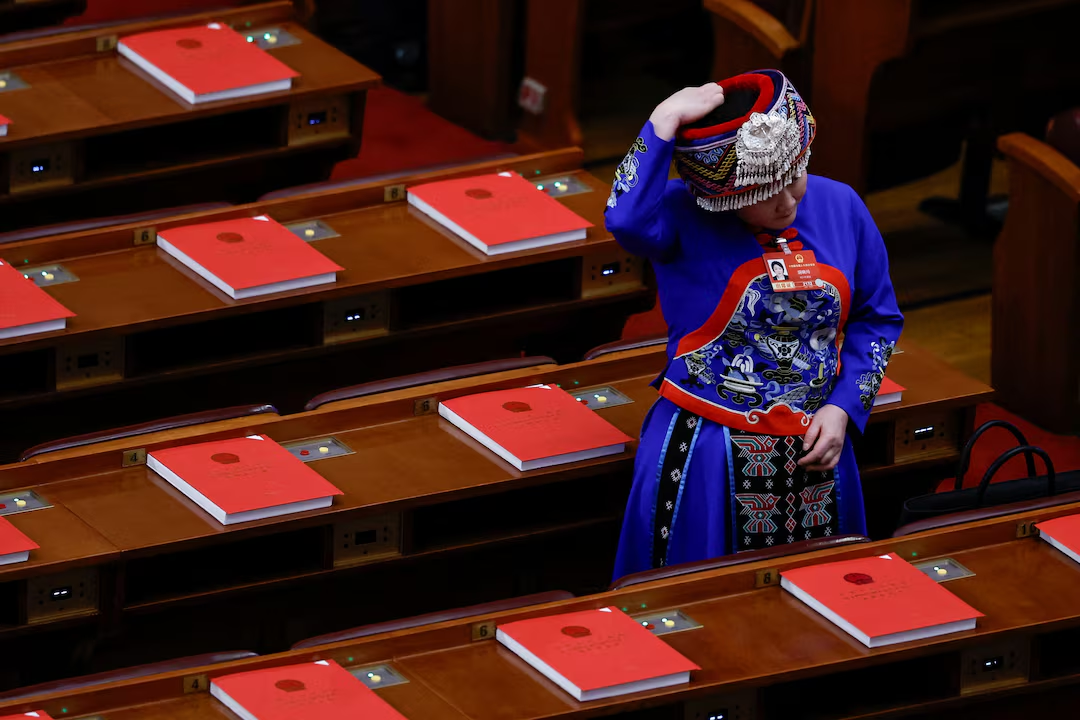
China has approved a far-reaching new law aimed at promoting what authorities describe as “ethnic unity,” a move that critics warn could further weaken the cultural and linguistic rights of minority groups.
The legislation seeks to strengthen integration among China’s 56 officially recognised ethnic groups, the majority of which are dominated by the Han Chinese population. While the policy focuses on areas such as education and housing, critics argue that it may limit the ability of minority communities to preserve their languages and cultural traditions.
Under the new law, children will be required to learn Mandarin from before kindergarten through the end of high school. In the past, many students in minority regions were able to study most subjects in their native languages, including Tibetan, Uyghur, or Mongolian.
The measure was approved on Thursday at the National People’s Congress in Beijing, as the country’s annual parliamentary session concluded.
Scholars and analysts say the policy reflects a broader shift in government strategy toward reducing ethnic diversity in favour of stronger national integration. Some academics argue that the approach may isolate younger generations from their traditional languages and cultural heritage.
Chinese authorities, however, say promoting Mandarin will improve employment opportunities and social mobility for minority communities. Officials also describe the law on “Promoting Ethnic Unity and Progress” as essential to advancing modernisation and strengthening national cohesion.
The legislation also allows authorities to take action against parents or guardians accused of promoting ideas considered harmful to ethnic harmony. In addition, it encourages the creation of “mutually embedded community environments,” a concept that some analysts believe could lead to the restructuring of neighbourhoods largely populated by minority groups.
China began emphasising what it calls the “sinicisation” of minority communities in the late 2000s as part of efforts to build a stronger national identity centred on integration with the dominant Han culture. Han Chinese account for more than 90 per cent of the country’s population of about 1.4 billion people.
For years, the Chinese government has faced accusations of restricting the rights of minority populations in regions such as Tibet, Xinjiang and Inner Mongolia. Critics say assimilation policies in these areas have often been implemented through state-led initiatives that intensified under President Xi Jinping’s leadership.
In Tibet, authorities have taken control of monasteries and detained monks as part of efforts to limit influence from exiled spiritual leader the Dalai Lama.
In Xinjiang, human rights organisations have reported the detention of large numbers of Uyghur Muslims in facilities the Chinese government describes as “re-education” centres. The United Nations has accused Beijing of serious human rights violations in the region, allegations the Chinese government denies.
Protests have also occurred in Inner Mongolia. In 2020, ethnic Mongolians staged demonstrations after authorities introduced policies reducing the use of the Mongolian language in schools in favour of Mandarin. Some parents kept their children out of school in protest, arguing that the change threatened their cultural identity. Authorities responded by moving quickly to suppress the demonstrations.
China’s constitution states that ethnic groups have the right to use and develop their own languages and exercise a degree of regional self-governance. However, critics argue that the new legislation may reinforce policies aimed at deeper assimilation into the dominant national culture.
Some analysts believe the law reflects a broader vision of building a unified and powerful Chinese nation centred on the Han majority, with minority groups expected to integrate more closely into that framework.
They warn that the policy could lead to increased control over minority communities and further pressure on traditional languages and cultural practices.