

 Lifestyle & Wellness Desk
Middle East Airspace Shuts Down as US-Israel Strikes Trigger Flight Disruptions
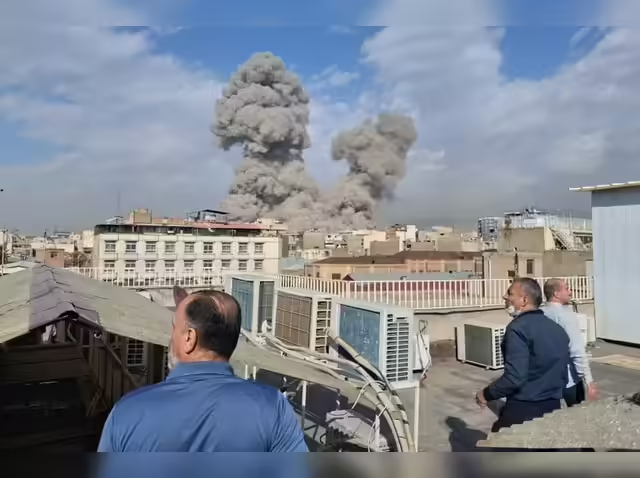
Air travel across the Middle East faced major disruption on Saturday after the United States and Israel launched military strikes on Iran, prompting several countries to close or restrict their airspace.
Countries including Iran, Iraq, Israel, Syria, Kuwait, and the United Arab Emirates announced full or partial airspace closures following explosions reported in Tehran and retaliatory military activity across the region.
Multiple Countries Close Airspace
Iran immediately shut its entire airspace until further notice, while Israel also suspended civilian flights nationwide, according to its transport authorities.
Iraq followed with a complete airspace closure, while the United Arab Emirates announced a temporary and partial restriction of its skies. Syria also restricted southern air corridors near its border with Israel for 12 hours.
Meanwhile, Jordan heightened its air defence readiness and reported intercepting ballistic missiles. Kuwait’s military also confirmed engaging incoming missile threats and subsequently closed its airspace.
Major Airlines Cancel Flights
Several global airlines announced widespread flight cancellations due to safety concerns and restricted airspace.
Airlines including Air France, Air India, Turkish Airlines, Lufthansa, Air Algerie, and Norwegian Air Shuttle suspended or cancelled multiple flights across the region.
Air India halted all Middle East operations, while Turkish Airlines suspended flights to several countries including Lebanon, Syria, Iraq, Iran, and Jordan. Lufthansa cancelled flights to key cities such as Tel Aviv, Beirut, Amman, Erbil, and Tehran, and temporarily halted services to Dubai and Abu Dhabi.
Other carriers, including British Airways and Swiss International Air Lines, also suspended flights to major regional destinations including Tel Aviv, Bahrain, and Dubai.
Global Flight Disruptions Increase
Russia’s aviation authority suspended commercial flights to Israel and Iran, while flight monitoring data showed widespread global disruption. By late morning, more than 9,600 flights had been delayed worldwide, with over 500 cancellations reported.
The airspace closures highlight growing regional tensions and their immediate impact on global aviation, with airlines continuing to monitor the situation before resuming normal operations.