Author: Ifeanyi Enukorah

Ifeanyi Enukorah18 January 2026
47.png

5min11260
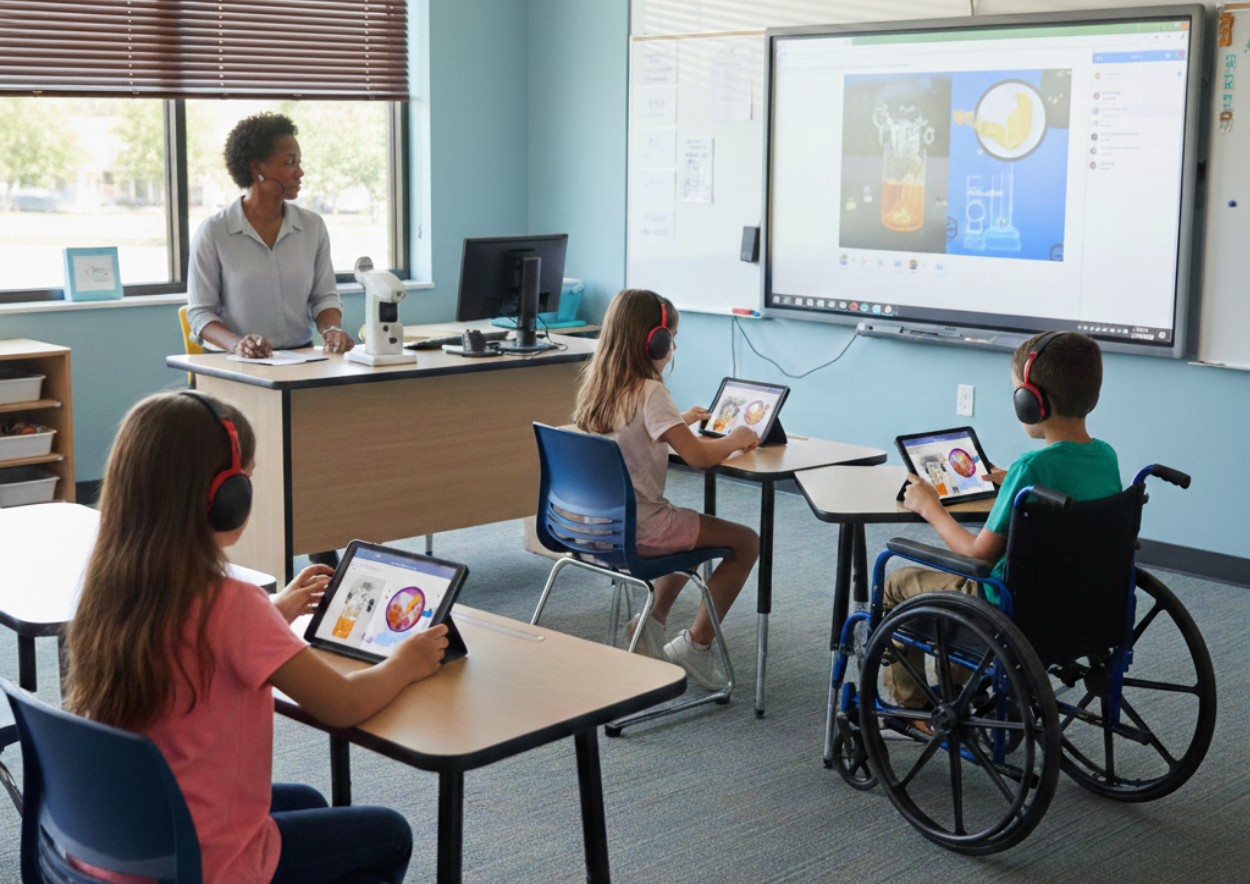
As an Amazon Associate, I earn from qualifying purchases. Education leadership is not just about the “big picture”; it is about the granular details of the learning environment. In my role as a facilitator, I often discuss how the physical and digital setup of a classroom can either act as a barrier or a bridge to student success. To build a truly “Connected Classroom” in 2026, you must prioritize tools that enhance visibility, auditory clarity, and focused engagement. Here are the hardware essentials that belong in every modern learning space. The Vision: Ultra-HD Document Cameras The days of students crowding around a single desk to see a science experiment or a math proof are over. Visibility is a prerequisite for equity in the classroom. Top Recommendation: IPEVO V4K PRO Ultra HD. Why it works for you: These devices feature an 8MP sensor that can project tiny details—like the grain of a leaf or the circuitry of a motherboard—onto a large screen with 4K clarity. Facilitator Insight: I recommend the DO-CAM for mobile educators. It folds completely flat, fitting into a laptop bag, making it perfect for “roving” facilitators who need to set up a high-quality demonstration in seconds. Check on Amazon (As an Amazon Associate, I earn from qualifying purchases): IPEVO V4K PRO – https://amzn.to/461EsuD   The Audio: Teacher Voice Amplification Systems One of the most overlooked causes of teacher burnout is “vocal strain”. Furthermore, if a student at the back of the room cannot hear clearly, they will naturally disengage. Top Recommendation: AVer AmpliWave. Why it works for you: These systems use wearable, lightweight microphones to amplify your natural speaking voice evenly across the entire room (up to 1,500 sq ft). Facilitator Insight: In my leadership sessions, we call this “Auditory Equity.” When you use a SoundField system, you don’t have to shout to be authoritative. You can maintain a calm, conversational tone that reduces classroom anxiety while ensuring every instruction is heard. Check on Amazon9As an Amazon Associate, I earn from qualifying purchases): AmpliWave Classroom Audio System – https://amzn.to/4r0G686    The Focus: Noise-Canceling Language Learning Headsets For language acquisition and focused digital work, the “soundscape” of the classroom is critical. Students need to hear the subtle inflections of a new language without the distraction of background chatter. Top Recommendation: TWT Audio REVO Series. Why it works for you: These headsets offer Active Noise Cancellation (ANC) and boom microphones that isolate the student’s voice, which is essential for accurate pronunciation feedback in language apps. Facilitator Insight: We see a massive boost in student confidence when they use high-quality headsets. It creates a “personal learning bubble” that allows even the most soft-spoken students to practice their speech without feeling self-conscious. Check on Amazon (As an Amazon Associate, I earn from qualifying purchases): Language Learning Headsets – https://amzn.to/4bCzLuS

Ifeanyi Enukorah18 January 2026
46.png

4min7760
As an Amazon Associate, I earn from qualifying purchases. In my experience as a Principal Facilitator and Director of Learning and Development, I’ve observed a consistent challenge: “Decision Fatigue.” Modern school administrators are often overwhelmed by a mountain of data, scheduling conflicts, and staff coordination tasks that divert them from their primary mission: instructional leadership. To move from being “busy” to being “strategic,” your physical workspace must evolve. Below are the essential tools I recommend for retrofitting your office into a high-efficiency command center. The Hub: The High-Performance Professional Tablet For the modern “Edupreneur,” the desk is no longer the anchor. You need a device that transitions seamlessly from a budget meeting to a classroom walkthrough. Top Recommendation: Apple iPad Pro M4 (13-inch) or Samsung Galaxy Tab S11 Ultra. Why it works for you: These devices feature advanced AI engines (like Apple Intelligence and Google Gemini) that can instantly summarize long meeting transcripts, automate scheduling, and even help with “Sketch-to-Image” visualization for your next staff presentation. Facilitator Insight: I use my tablet for “Walking Leadership.” With a tablet and a stylus, I can record observations during a classroom visit and have them synced to the teacher’s professional development file before I even leave the room. Check on Amazon (As an Amazon Associate, I earn from qualifying purchases): Apple iPad Pro M4 – https://amzn.to/49JNOw6 Samsung Galaxy Tab S11 Ultra – https://amzn.to/4b2e3jT   The Support: Ergonomic Workstation Essentials Leadership is a marathon, not a sprint. If your physical environment causes strain, your mental performance will eventually decline. Top Recommendation: Adjustable Laptop/Tablet Risers and Standing Desk Converters. Why it works for you: Elevating your screen to eye level prevents the “neck tilt” that causes headaches during long administrative sessions. A standing desk converter allows you to switch between sitting and standing, keeping your energy levels high during the school day. Facilitator Insight: In our workshops on organizational excellence, we discuss the “90-degree rule”—your elbows should always be at a 90-degree angle when typing to avoid long-term wrist strain. Check on Amazon (As an Amazon Associate, I earn from qualifying purchases): Ergonomic Laptop Stand – https://amzn.to/4pLEHBc Sit-Stand Desk Converters – https://amzn.to/3NsR8V0   The Automation: Smart Speakers for the Front Office While often seen as home gadgets, smart assistants like the Amazon Echo (Alexa) or Google Nest are powerful administrative partners. The Impact: Use them for hands-free timers during staff meetings, setting reminders for student pick-up transitions, or playing focus-enhancing background audio in the reception area. Check on Amazon (As an Amazon Associate, I earn from qualifying purchases): Alexa-Enabled Smart Speaker – https://amzn.to/4b6Px18  

Ifeanyi Enukorah23 August 2025
Maths-1280x853.png

5min15730
The question of how best to teach mathematics continues to generate debate in Nigeria’s education sector, particularly between general education teachers and those in special education. For years, policymakers and educators have sought ways to improve learning outcomes in mathematics, one of the subjects in which Nigerian students continue to perform poorly in WAEC, NECO, and JAMB. But as seen in other parts of the world, there is no consensus on what good mathematics teaching should look like. The Debate: Inquiry vs. Explicit Instruction One central point of disagreement is whether teachers should encourage what is called “productive struggle.” This approach involves giving students challenging, open-ended problems that encourage them to grapple with mathematical concepts and persevere to find solutions. General educators often support this model because it promotes problem-solving skills and independent thinking. Special educators, however, worry that such approaches could frustrate learners with disabilities or those who struggle with number sense. They prefer explicit, step-by-step teaching, where the teacher models how to solve problems before students are allowed to attempt more complex questions on their own. This tension between inquiry-based learning and explicit instruction is not unique to Nigeria. A recent study by researchers from the University of Virginia, Boston University, and the University of Delaware highlights how general and special education researchers in the United States conceptualize mathematics teaching differently. According to Nathan Jones, one of the authors, these divides often begin from how teachers are trained in colleges and universities, and they have widespread implications in classrooms. What Counts as Success in Mathematics? The study also revealed different ideas of what “success” in mathematics means. Special education researchers often focus on measurable outcomes such as mastering curriculum standards or preparing students for the next stage of schooling. General education researchers, in contrast, emphasize broader goals such as fostering joy in mathematics or encouraging students to use mathematical thinking in civic life. These findings resonate in the Nigerian context. For many teachers in Nigeria, particularly in special education, success in mathematics is often equated with passing WAEC or NECO. Yet there is growing advocacy among curriculum reformers that mathematics should also help students develop critical thinking skills, creativity, and practical problem-solving abilities beyond examinations. Policy and Practice in Nigeria Nigeria has committed to strengthening inclusive education through policies that promote access for learners with disabilities. However, the lack of consensus on effective teaching approaches in mathematics mirrors the challenges highlighted by international researchers. Julie Cohen, one of the study’s authors, noted that high-quality instructional materials often privilege inquiry-based methods, but techniques researched in special education, such as systematic and explicit instruction, can help scaffold learning for struggling students. In Nigeria, where classrooms are often overcrowded and teacher training uneven, these scaffolding strategies may be crucial to ensuring that no student is left behind. The debate also underscores the need for reforms in teacher education. Most Nigerian mathematics teachers receive little or no training on inclusive pedagogies, while special educators may not be exposed to modern inquiry-based methods. Bridging this divide in training could improve outcomes for all learners. Moving Forward The lesson for Nigeria is clear. Just as researchers abroad have argued, there should not be “winners and losers” in the mathematics education debate. A blended approach is needed, one that combines inquiry-based exploration with explicit instruction and guided practice. As Jones and his colleagues concluded, the best way forward is to design instruction with marginalized students in mind. For Nigeria, this means ensuring that learners with disabilities and those who struggle with mathematics are placed at the center of instructional planning.

Ifeanyi Enukorah17 August 2025
Teachers.png

2min35090
Artificial intelligence (AI) is rapidly changing industries across Africa, but its role in education is still emerging. For many schools, the big question is: how do we prepare teachers to use AI meaningfully in the classroom? A recent international study suggests an answer that may surprise many: the best way for teachers to learn AI is not just to be trained on it—but to design the tools themselves. From California to African Classrooms In California, over 80 teachers across 18 schools were given hands-on training to build and test AI tools that directly addressed classroom challenges. Instead of passively learning, they designed apps that differentiated lessons, encouraged teamwork, and even helped manage student behavior. One school created a chatbot to strengthen teacher collaboration, while another designed an app that automatically generates restorative discipline activities, complete with reading passages and parent letters. These tools saved time, supported student growth, and improved teacher confidence with AI. Lessons for Africa For Africa, where teachers face large class sizes, multilingual learners, and limited resources, the takeaway is powerful: teachers are not just end-users—they should be innovators. Imagine African teachers designing AI tools that: Translate lessons into local languages. Generate quick remedial activities for struggling learners. Provide culturally relevant teaching examples. Support overworked teachers with ready-to-use lesson adjustments. But while AI can lighten workloads, it cannot replace relationships. As teachers in the study warned, trust and human connection remain the foundation of learning. AI should strengthen—not weaken—that bond. The Way Forward If Africa is to harness AI in education, policymakers and EdTech investors must go beyond importing technology. They must empower teachers to co-create AI solutions that fit African realities. When teachers lead innovation, AI becomes more than a buzzword. It becomes a partner in solving the continent’s most pressing education challenges.

Ifeanyi Enukorah10 August 2025
Gemini_Generated_Image_v39achv39achv39a-1280x1280.png

11min14530
In the dynamic and competitive landscape of private education, a school’s success is often measured by its academic results and the caliber of its teaching staff. However, behind every great school is a dedicated team of non-teaching staff, the administrative, finance, maintenance, security, and support personnel, who form the operational backbone of the institution. These individuals ensure the school runs smoothly, safely, and efficiently. A well-managed and motivated non-teaching team doesn’t just support the teachers; they are a critical component of the school’s overall performance, student experience, and reputation. Why Non-Teaching Staff Management Matters The performance of your non-teaching staff directly impacts the entire school ecosystem. A disgruntled or inefficient receptionist can create a poor first impression for prospective parents. A slow or disorganized admissions team can lead to missed enrollment opportunities. Maintenance staff who are not engaged can result in a poorly kept campus, affecting morale and even safety. In contrast, an engaged and well-managed team of non-teaching staff can transform the school environment, enhance operational efficiency, and significantly contribute to a positive school culture. Their work ensures that teachers can focus on their core duty—teaching—and that students have a supportive and conducive learning environment.1 Key Strategies for Managing Non-Teaching Staff Effective management of this vital group requires a structured and deliberate approach. School leaders must move beyond a reactive management style and adopt a proactive, strategic perspective. Clear Job Descriptions and Expectations One of the most common issues is a lack of clarity regarding roles and responsibilities. To counter this, every non-teaching staff member should have a clear, well-defined job description outlining their key duties, reporting lines, and performance metrics. These descriptions shouldn’t just be static documents; they should be reviewed and discussed regularly. During the hiring process and at the start of each academic year, leaders should have one-on-one meetings to set clear expectations and discuss how each role contributes to the school’s mission. Effective Supervision and Feedback Mechanisms Supervision should be constructive and continuous, not just corrective. Leaders should establish a consistent feedback mechanism that includes regular check-ins, performance reviews, and informal conversations. Feedback should be specific, timely, and focused on both strengths and areas for improvement. For instance, a finance officer could receive feedback not just on their budget reports but also on their communication with parents regarding tuition payments. A well-structured performance management system can help, but the key is to foster a culture of open communication where staff feel comfortable seeking guidance and clarification without fear of reprisal. Providing Necessary Resources and Training A school can’t expect high performance from its staff without equipping them with the right tools and skills. This includes providing necessary resources, such as up-to-date software for administrative staff, proper equipment for maintenance crews, and a secure and efficient communication system. Furthermore, continuous training and professional development are crucial. A receptionist could benefit from a workshop on customer service and communication skills, while an accountant might need training on the latest accounting software. Investing in their growth shows that the school values their contribution and is committed to their success. Communication and Inclusion in School Culture Non-teaching staff often feel like a separate entity from the teaching staff, which can lead to a “them versus us” mentality. This is a significant barrier to a cohesive school culture. To overcome this, school leaders must actively include non-teaching staff in school life. This means inviting them to school-wide meetings, celebrating their birthdays and work anniversaries, and including their updates in school newsletters. A simple act, such as the principal personally greeting the security guards each morning, can go a long way in fostering a sense of belonging and mutual respect. Motivation Techniques that Work in Private Schools Motivating non-teaching staff goes beyond just paying their salaries. It involves creating an environment where they feel valued, respected, and essential to the school’s success. Recognition and Appreciation Everyone wants to feel seen and appreciated for their hard work. Recognition can be formal or informal. Formal recognition could include “Employee of the Month” awards, shout-outs in staff meetings, or a bonus for exceptional performance. Informal gestures, like a simple “thank you” or a note of appreciation from a school leader, can be equally powerful. For example, a principal could send a handwritten note to the head of maintenance after a successful campus event, acknowledging the team’s hard work in keeping the grounds pristine. Career Growth and Training Opportunities In private schools, non-teaching roles are not always seen as having a clear career path. However, leaders can create opportunities for growth. This could involve cross-training, where a junior administrator learns a new skill from the finance department, or creating a pathway for a security officer to become a supervisor. Offering to sponsor training or certifications in their field shows a commitment to their long-term development. This not only motivates the individual but also builds a more skilled and versatile workforce. Creating a Supportive and Respectful Work Environment A school’s culture is a major motivator. Leaders must model and enforce a culture of respect, fairness, and support. This means addressing conflicts promptly, ensuring fair treatment of all staff regardless of their role, and creating a safe space where individuals can voice concerns without fear of retaliation. A supportive environment is one where staff feel comfortable taking a personal day when needed and where their well-being is considered. This culture of care is particularly important in private schools, where staff often work long hours and are deeply invested in the school’s mission. Fair Compensation and Incentives While motivation isn’t solely about money, fair compensation is a foundational element. Private schools must ensure their salaries for non-teaching staff are competitive with the local market. Offering performance-based incentives or year-end bonuses tied to the school’s overall performance or specific operational goals (e.g., successful accreditation, hitting enrollment targets) can also be a powerful motivator. Regular salary reviews and transparent compensation policies build trust and reduce turnover. Challenges School Leaders Face & How to Overcome Them Managing non-teaching staff is


Ifeanyi Enukorah17 February 2025
pictures-1280x744.jpg

7min5550
In today’s fast‐paced educational landscape, school leaders face a myriad of challenges, from adapting to evolving curriculum standards and budget constraints to meeting the diverse needs of students and staff. Amid these challenges, one powerful tool often goes underutilized: networking. Far more than exchanging business cards, effective networking creates a dynamic web of support, ideas, and resources that can transform leadership and, ultimately, school outcomes. What Does Networking Mean for School Leaders? Networking for school leaders is the deliberate process of building lasting relationships with fellow educators, mentors, and experts from across the field. It’s about connecting with individuals who share a commitment to educational excellence and who can offer fresh perspectives on persistent challenges. These connections create a collaborative ecosystem where ideas are exchanged freely, successes are celebrated together, and hurdles are tackled collectively. The Benefits of a Strong Professional Network Enhanced Problem-Solving and Innovation: When school leaders tap into a diverse network, they open themselves up to a rich reservoir of ideas and proven strategies. Whether it’s a novel classroom management technique or an innovative approach to community engagement, hearing how others have navigated similar challenges can spark creative solutions in your own school. Mentorship and Continuous Growth: Networking provides direct access to seasoned educators who have been through the ups and downs of school leadership. These mentors offer guidance, share lessons learned, and provide a safe space for discussing the complexities of the role. Their insights can accelerate your professional development and help you refine your leadership style. Emotional and Professional Support: Leadership can be isolating. Regular interactions with peers who truly understand the demands of the job can provide not only practical advice but also emotional reassurance. Whether it’s sharing a success story or venting about a tough day, these relationships help sustain resilience and foster a culture of collective well-being. Resource Sharing and Collaboration: A robust network serves as a live repository of best practices, innovative tools, and essential resources. Through regular meetings, online forums, or professional learning communities, school leaders can share lesson plans, data insights, and even professional development opportunities that benefit the entire community. Strategies for Building Your Network Attend and Engage: Participate in conferences, workshops, and local educational events. These gatherings are not only opportunities to learn about the latest trends and research but also ideal settings for meeting like-minded professionals. Consider events that focus on leadership development or school improvement initiatives, these are fertile grounds for making meaningful connections. Leverage Digital Platforms: In today’s interconnected world, geographic boundaries are no longer barriers. Join online communities, social media groups, and virtual forums dedicated to educational leadership. Platforms such as LinkedIn, Twitter, and specialized educator forums can help you connect with peers and experts from around the globe. Cultivate Existing Relationships: Sometimes the best opportunities lie right under your nose. Look within your own district or professional circles to identify colleagues who are natural advice givers or innovators in their own right. Regular check-ins, informal coffee chats, or collaborative projects can strengthen these relationships and spark new ideas. Create a Culture of Collaboration: Encourage a mindset that values sharing and collective growth. By fostering professional learning communities (PLCs) or peer mentoring groups within your school, you can help break down silos and build a culture where every voice contributes to the greater good. Overcoming Common Networking Challenges Despite its many benefits, networking can sometimes feel overwhelming. Busy schedules, limited time, and even a tendency toward professional isolation may hinder your efforts. To overcome these barriers: Prioritize Quality Over Quantity: Focus on cultivating a few deep, meaningful relationships rather than attempting to connect with everyone at once. Use Technology to Your Advantage: Virtual meetings, webinars, and online discussion boards can help bridge the gap when face-to-face interactions aren’t possible. Be Open and Authentic: Share your challenges and successes honestly. Vulnerability fosters trust and paves the way for reciprocal support and genuine collaboration. A Call to Action Investing time and energy into building a strong professional network isn’t a luxury—it’s a necessity for effective school leadership. When leaders come together to share ideas, mentor one another, and collaborate on solutions, they create a ripple effect that benefits not only themselves but their entire school community. By embracing the power of networking, you are not just solving problems; you’re pioneering a culture of continuous improvement, innovation, and shared success. So, take that first step; reach out, connect, and build the bridges that will carry your school community into a brighter, more collaborative future. Together, we can transform challenges into opportunities and empower every school leader to thrive in today’s dynamic educational environment.

Ifeanyi Enukorah10 February 2025
school-leader-1280x744.jpg

6min7200
Introduction In 2025, school leaders are at the forefront of significant transformations in education. From technological advancements to evolving pedagogical approaches, shifting policies, and changing societal expectations, navigating change effectively is a crucial skill for educational leaders. Successfully managing change requires strategic thinking, adaptability, and strong communication. This article explores key strategies school leaders can employ to navigate change management effectively in 2025. Understanding the Need for Change Change in education is driven by various factors, including: Technological Innovations: AI-driven learning tools, virtual classrooms, and adaptive learning platforms are reshaping teaching methodologies. Policy and Curriculum Reforms: Governments worldwide are revising educational frameworks to align with the demands of the future workforce. Societal Shifts: Increasing emphasis on inclusivity, diversity, and mental well-being in schools requires leaders to foster a supportive environment. Economic and Global Influences: Budget constraints, globalization, and the demand for skills-based education necessitate continuous adaptation. Key Strategies for Effective Change Management 1. Develop a Clear Vision and Purpose School leaders must articulate a clear vision that aligns with institutional goals and communicates the purpose of change. A well-defined roadmap fosters a sense of direction and ensures stakeholders understand the broader objectives. 2. Engage Stakeholders Early and Often Change is more effective when key stakeholders (including teachers, students, parents, and policymakers) are involved in the decision-making process. Open communication fosters trust and reduces resistance. Conduct surveys and focus groups to gather input. Hold regular meetings to address concerns and provide updates. 3. Enhance Professional Development for Educators A well-prepared teaching staff is crucial for successful change implementation. Provide targeted training sessions. Encourage continuous learning through workshops and online courses. Offer mentorship programs to help teachers adapt to new methodologies. 4. Leverage Technology for Seamless Transition Incorporating digital tools can make change implementation smoother. Use AI-powered analytics to assess student progress. Implement learning management systems (LMS) to streamline curriculum delivery. Utilize communication platforms to keep stakeholders informed. 5. Create a Culture of Adaptability and Resilience Encouraging a growth mindset among staff and students fosters an environment where change is seen as an opportunity rather than a challenge. Celebrate small wins to motivate teams. Promote collaboration and knowledge-sharing. Implement feedback loops to refine strategies. 6. Address Resistance with Empathy Resistance to change is natural. School leaders must approach opposition with empathy and provide necessary support to ease transitions. Identify concerns and address them proactively. Provide clear explanations on the benefits of change. Offer coaching and support where needed. 7. Monitor Progress and Adapt Strategies Change management is an ongoing process that requires constant evaluation. Set measurable goals and key performance indicators (KPIs). Collect data and adjust approaches based on feedback and results. Remain flexible and open to modifying plans as necessary. Conclusion As 2025 unfolds, school leaders must embrace change with confidence, strategic planning, and effective leadership. By fostering a clear vision, engaging stakeholders, leveraging technology, and cultivating adaptability, school leaders can ensure a smooth transition in an ever-evolving educational landscape. Change is inevitable, but with the right approach, it can be a powerful force for growth and innovation in schools.