Category: Performance & Essentials

Ifeanyi Enukorah9 February 2026
53.png

4min8820
In the traditional hierarchy of education, the “Great Man” or “Heroic Leader” theory has long dominated. We’ve been taught to look to a single Principal or Head of School as the sole architect of a school’s destiny. But in an era defined by increasing complexity, rapid digital transformation, and heightening student needs, the weight of a school is simply too heavy for one pair of shoulders. To build truly resilient, high-performing schools, we must shift from leadership as a position to leadership as a practice. This is the essence of Shared Leadership. What is Shared Leadership? Shared leadership (often referred to as distributed leadership) is not simply “delegating tasks” to lighten the Principal’s load. It is a strategic cultural shift where leadership is fluid and based on expertise rather than title. It is the collaborative effort of staff, teachers, and administrators to take ownership of the school’s vision and instructional outcomes. Why It Matters: The Value Proposition When leadership is shared, the school moves from a model of “compliance” to a model of “commitment.” The benefits are measurable and transformative: Increased Instructional Quality: Teachers are the closest to the “engine room” of learning. When they are empowered to lead professional learning communities (PLCs), pedagogical innovation flourishes. Reduced Leader Burnout: By distributing the cognitive and emotional load, school heads can focus on high-level strategy and culture rather than being bogged down in every micro-decision. Enhanced Retention: Educators stay where they feel valued. Shared leadership provides a career pathway for “teacher-leaders” who want to make an impact without leaving the classroom. Organizational Agility: Schools with distributed networks respond faster to crises. Information flows more freely, and solutions are generated by those closest to the problem. Case Studies in Excellence The Turnaround Model: Western High A struggling urban secondary school faced declining test scores and high staff turnover. The new principal implemented a “Leadership Cabinet” comprising department heads and veteran teachers. They were given autonomy over their own budgets and professional development schedules. The Result: Within two years, teacher turnover dropped by 40%, and student literacy rates improved by 15% because the “owners” of the curriculum were the ones driving the change. The Innovation Hub: St. Jude’s Primary St. Jude’s moved away from traditional staff meetings toward “Innovation Circles.” Any staff member could propose a pilot project (e.g., a new blended learning model) and lead a small team to implement it. The Result: The school became a regional leader in EdTech. The Principal acted more as a “Coach-in-Chief,” facilitating resources while the faculty drove the school’s competitive edge. Moving Forward: The First Step Shared leadership does not mean the Principal becomes less important; it means they become more impactful. Your role shifts from being the “knower of all things” to the “architect of talent.” The most successful schools of the next decade will be those that realize the smartest person in the room is not a person at all—it is the room itself. Ifeanyi Enukorah, PhD ifeanyienukorah@gmail.com

Ifeanyi Enukorah8 February 2026
National-Online-Safety.png

1min6580
How confident are you when it comes to online safeguarding? To mark National Online Safety Day (Tuesday, 10th February), Safeguarding Scenarios is offering a free national survey to explore our attitudes and confidence in keeping children safe online. Pause. Reflect. Act. This isn’t a test with a “right” or “wrong” answer. Instead, it’s a 2-minute real-life scenario designed to help you pause and reflect on the complexities of the digital world. [Click here to take the scenario] 👉 https://safeguardingscenarios.com/national-online-safety-day-scenario/ Important Dates National Online Safety Day: Tuesday, 10th February Closing Date: Midnight, Tuesday, 17th February 2026 Whether you are an educator, a parent, or a student, your perspective helps build a clearer picture of digital safety today. Please take two minutes to participate and share the link with your colleagues and networks. For more information on these scenarios, visit www.safeguardingscenarios.com

Event & Hosting Desk7 February 2026
Mashmelow-DJ.jpg

3min7820
Editor’s Note: This article contains affiliate links. As an Amazon Associate, I earn from qualifying purchases. In the world of leadership and facilitation, we often talk about the power of “Presence.” Sometimes, making a statement isn’t about what you say, but about the energy you bring to the room. Whether you’re a professional DJ, a cosplay enthusiast, or just looking to be the life of the party, the Candora Marshmello Full Head DJ Mask is the ultimate tool for a high-impact entrance. Why This Mask is a Must-Have for 2026 This isn’t just a costume piece; it’s a portal into the high-energy world of electronic music and modern performance. Breathable Engineering: Unlike many cheap imitations, this full-head helmet is designed with mesh eye and mouth panels. Maximum Comfort: This provides vital ventilation, allowing you to perform, dance, or socialize for hours without the typical “mask fog” or discomfort. Universal Professional Fit: The one-size-fits-most design is crafted from durable, lightweight materials, making it comfortable for both adults and teens. The “Bar & Club” Aesthetic: This specific model is built for low-light environments. Strobe-Ready Finish: Its clean, white finish “pops” under club lights and strobe effects, ensuring you remain the focal point of the event. Facilitator’s Insight: The Psychology of the Mask In my sessions, we explore how “Anonymity” can actually lead to greater creative expression. By wearing a mask like this, performers often find they can step into a more confident, high-energy version of themselves. It removes the barrier of self-consciousness, allowing the music and the moment to take over. The Choice for European Events For our community members in Germany and across Europe, we have selected this model for its reliability and high-quality, breathable materials. Get the Marshmello DJ Mask on Amazon Here: https://amzn.to/4rdEh7x (Paid Link)

Ifeanyi Enukorah1 February 2026
Valentine-Gift-Ideas-Final-1280x905.jpg

7min10140
As an Amazon Associate, Edupreneur earns from qualifying purchases. In my role as a facilitator, I often emphasize that the strongest communities—whether in schools or homes—are built on intentional appreciation. Valentine’s Day isn’t just for romance; it’s a vital “Season of Appreciation” to acknowledge the educators who inspire, the parents who support, and the students who strive every day. To build a more connected and supportive environment in 2026, we must prioritize gestures that foster well-being, focus, and joy. Here are the curated essentials for every member of your learning community. For Educators: The “Self-Care & Sanctuary” Kit Teaching is a high-output profession that requires significant emotional and physical energy. The best gift for an educator is one that facilitates a moment of sensory reset and professional comfort. Top Recommendation: Soy Wax Aromatherapy Candle Set. Why it works for you: These natural candles provide a calming atmosphere for grading or unwinding. Scents like lavender or eucalyptus help lower stress levels after a long day of instruction. Facilitator Insight: We call this “Environment Engineering.” In leadership workshops, I teach that your physical space dictates your mental state. A small aesthetic upgrade, like a high-quality candle or a sleek desk organizer, acts as a “micro-moment” of peace. Check on Amazon for the following suggested products: (As an Amazon Associate, Edupreneur earns from qualifying purchases) Aromatherapy Candle Sets Natur IX Calming Soy Scented Candles for Women | Non Toxic Soy Candles for Home, Birthday, Christmas Gifts & Aromatherapy | Organic Essential Oil, 50 H Burning | Lavender, Basil & Jasmine, 8.5 oz https://amzn.to/3NMJipz Professional Desk Decor Set of 4 – Concrete Desk Accessories For Modern, Industrial, Minimalist Office Decor- Aesthetic Desk Organizers Accessories For Women or Men- Pen, Business Card Holder & Sticky Note, Paper Clip Holder https://amzn.to/4br1dvG   For Parents & Guardians: Tools for Connection For parents, Valentine’s Day is an opportunity to strengthen family bonds through shared experiences. Moving beyond traditional candy allows for deeper engagement and the development of critical life skills. Top Recommendation: The Monopoly Family Board Game (8+ Edition). Why it works for you: It turns essential concepts like budgeting, risk assessment, and negotiation into a fun, hands-free evening. It’s an investment in your child’s financial literacy. Facilitator Insight: Game-based learning is one of the most effective ways to teach resilience. Facing “bankruptcy” in a game is a safe way for children to practice coping with losses and celebrating wins alongside their guardians. Check on Amazon for the following suggested products: (As an Amazon Associate, Edupreneur earns from qualifying purchases) Monopoly Board Game Hasbro Gaming Monopoly Sparkle Edition Board Game, Family Games, with Glittery Tokens, Pearlescent Dice, Sparkly Look, (Amazon Exclusive)  https://amzn.to/46fQeBL Family Connection Games 200 Family Conversation Cards – Put Down The Phones & Connect with Family – Get to Know Each Other Better with Meaningful Talk – Let Kids Express Themselves, Great for Dinner Table & Road Trips https://amzn.to/4k98kuV   For Students: The “Focus & Affirmation” Bundle Students thrive when their hard work is recognized. Providing tools that make their study environment more inviting and organized can directly impact their academic confidence and focus. Top Recommendation: Heart-Shaped Super Sticky Notes. Why it works for you: These are vibrant and functional, perfect for marking key concepts in textbooks or leaving positive affirmations on a study desk. Facilitator Insight: Visual cues are powerful memory aids. Encouraging students to use unique shapes for their most important goals helps with retention and makes long study sessions feel more personalized and engaging. Check on Amazon for the following suggested products: (As an Amazon Associate, Edupreneur earns from qualifying purchases) Heart-Shaped Post-its Teling 24 Pack Valentine’s Day Sticky Notes Heart Lined Sticky Notes Self Adhesive Love Memo Pads for Valentines Party Exchange Gifts Office Home School 3×3 Inch(Bright Color,Classic) https://amzn.to/4roObDF Student Productivity Tools Rotating Pomodoro Timer 5, 25, 10 50 Minutes Preset, Desk Productivity Flip Timer, ADHD Tool Cube Countdown Stopwatch, Vibration/High/Low Volume/Custom Modes, for Work, Study, Back to School, Kitchen https://amzn.to/4tb4ANF  

Tech & Tools Desk28 January 2026
NAMANI-headset-2.png

3min8030
Editor’s Note: This article contains affiliate links. As an Amazon Associate, I earn from qualifying purchases. In my journey as a Principal Facilitator, I’ve realized that an educator’s greatest asset isn’t just their knowledge—it’s their ability to multitask without losing focus. Whether you are leading a virtual workshop, coordinating with a “Gateway team” on curriculum, or simply trying to stay productive during a long commute, your tools should set you free, not tie you down. To stay effective in a digital-first school environment, you need a communication tool that offers professional-grade clarity without the weight of a traditional headset. The Multi-Tasking Must-Have: Pro Bluetooth Earpieces Modern education demands that we move. From the classroom to the administrative office, being tethered to a laptop by a wire is a barrier to “walking leadership.” The Comparison: Why This Choice Matters. While many educators look at high-end over-ear headphones (like Bose or Sony) or standard consumer earbuds (like AirPods), they often fall short for professional educational use: Over-Ear Headphones: Can feel heavy and isolating during an 8-hour workday, and they aren’t practical for “on-the-move” coordination. Standard Earbuds: Often have poor microphone isolation in noisy hallways and a battery life that won’t last through back-to-back parent-teacher conferences. Top Recommendation: NANAMI Bluetooth Headset V5.0 Why it works for you: The “Marathon” Battery: With up to 320 hours of standby time and nearly 24 hours of talk time, you can go a full week without worrying about a charge. Ultralight Comfort: At a fraction of the weight of over-ear models, it features a 180° rotatable ear hook. You can switch ears throughout the day to prevent fatigue. Crystal Clear Mic: The rotatable, noise-canceling microphone ensures that even if you’re in a busy staff room or driving to a facilitation site, your voice remains clear and authoritative. Facilitator Insight: I’ve found that the best tool is the one you forget you’re wearing. This earpiece lets you keep one ear open to your surroundings (essential for school safety and student supervision) while staying perfectly connected to your digital tasks. It is the ultimate bridge for the busy Edupreneur. Check on Amazon: NANAMI Bluetooth Headset (320Hrs Standby) – https://amzn.to/4k74mmP (Paid Link)

Ifunanya Okafor28 January 2026
Monopoly-3-1280x905.png

6min12560
As an Amazon Associate, Edupreneur earns from qualifying purchases. In an increasingly digital world, the challenge for parents and educators is finding engaging ways to teach critical life skills. While apps and online games have their place, the classic board game Monopoly – particularly the edition that includes Fan Vote Community Chest Cards – remains an unparalleled, hands-on tool for developing essential financial literacy, strategic thinking, and social skills in children aged 8 and up. As a Principal Facilitator with years of experience in educational development, I’ve seen firsthand how effective game-based learning can be. And when it comes to practical education, Monopoly isn’t just fun; it’s a powerful simulator for the real world. Beyond the Board: Key Learning Outcomes from Monopoly Monopoly’s enduring popularity for 2 to 6 players isn’t just about the thrill of owning properties. It’s about the invaluable lessons embedded in every roll of the dice and every property transaction. Financial Literacy Fundamentals: Budgeting & Money Management: Players learn to count money, make change, and manage their cash flow – simple yet crucial skills often overlooked in standard curricula. Investment & Risk Assessment: Deciding when to buy a property, build houses, or mortgage assets teaches the basics of investment, risk, and return. Children quickly grasp that smart investments can yield dividends, while reckless spending leads to bankruptcy. Debt & Assets: The concepts of owing money (rent) and owning valuable assets (properties) become tangible. The updated Fan Vote Community Chest Cards can even introduce modern financial scenarios that resonate more with today’s youth. Strategic Thinking & Planning: Resource Allocation: Players must strategically decide where to invest their limited funds for maximum impact. Should they prioritize buying a complete color set or diversify their portfolio? Negotiation Skills: Trading properties with opponents fosters negotiation, persuasion, and understanding mutual benefit – invaluable social skills for future interactions. Probabilistic Thinking: While based on chance, understanding the likelihood of landing on certain squares (especially those with houses) helps develop a rudimentary sense of probability. Social & Emotional Development: Patience & Turn-Taking: The game naturally teaches patience and respect for others’ turns, a vital skill for classroom and family harmony. Coping with Wins and Losses: Monopoly can be unpredictable. Learning to win gracefully and lose with resilience is a powerful emotional lesson that prepares children for life’s ups and downs. Rule Following & Fair Play: Adhering to the game’s rules reinforces the importance of structure and fairness in any system. Why This Edition is Perfect for Your Learning Arsenal The Monopoly Game, Family Board Game for 2 to 6 Players, Monopoly Board Game for Children from 8 Years, Includes Fan Vote Community Chest Cards, offers several advantages: Age Appropriateness: Specifically designed for children from 8 years, the rules are accessible, yet the strategic depth grows with the child. Family Engagement: It’s a fantastic way for 2 to 6 players to bond, creating shared experiences and memories away from screens. Parents can guide discussions around financial decisions, turning gameplay into teachable moments. Modern Relevance: The inclusion of Fan Vote Community Chest Cards means the game can evolve, incorporating contemporary events or dilemmas that children might encounter, making the lessons even more relevant. The Bottom Line for Schools, Parents, and Educators In a world demanding greater financial literacy and critical thinking, Monopoly is more than just a game; it’s a dynamic classroom in a box. It provides a safe, engaging environment for children to experiment with financial decisions, practice strategic thinking, and develop essential social skills that will serve them well into adulthood. Invest in a copy for your home or classroom today, and watch your children master money, strategy, and resilience, one property at a time. Check on Amazon: https://amzn.to/4ahkleq (As an Amazon Associate, Edupreneur earns from qualifying purchases.)

Ifeanyi Enukorah18 January 2026
47.png

5min11320
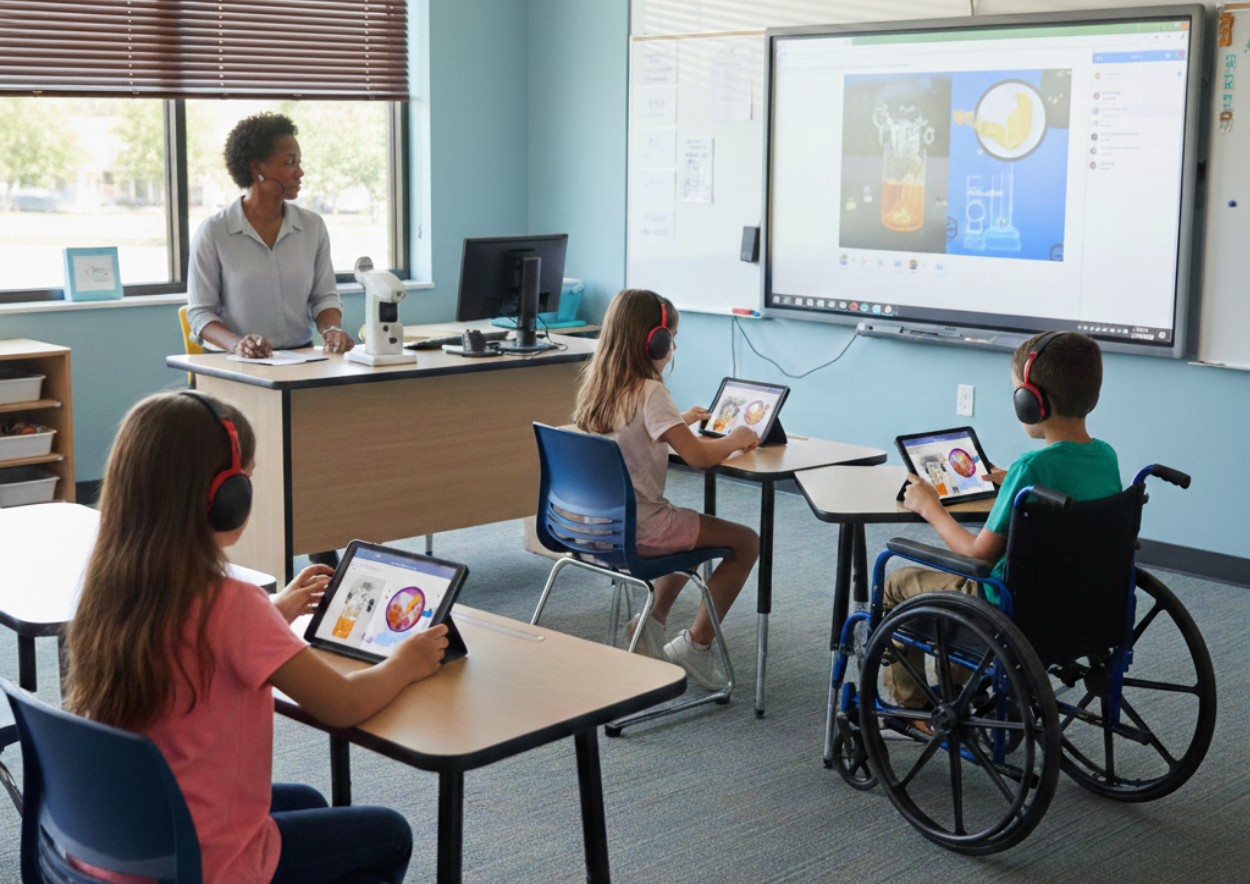
As an Amazon Associate, I earn from qualifying purchases. Education leadership is not just about the “big picture”; it is about the granular details of the learning environment. In my role as a facilitator, I often discuss how the physical and digital setup of a classroom can either act as a barrier or a bridge to student success. To build a truly “Connected Classroom” in 2026, you must prioritize tools that enhance visibility, auditory clarity, and focused engagement. Here are the hardware essentials that belong in every modern learning space. The Vision: Ultra-HD Document Cameras The days of students crowding around a single desk to see a science experiment or a math proof are over. Visibility is a prerequisite for equity in the classroom. Top Recommendation: IPEVO V4K PRO Ultra HD. Why it works for you: These devices feature an 8MP sensor that can project tiny details—like the grain of a leaf or the circuitry of a motherboard—onto a large screen with 4K clarity. Facilitator Insight: I recommend the DO-CAM for mobile educators. It folds completely flat, fitting into a laptop bag, making it perfect for “roving” facilitators who need to set up a high-quality demonstration in seconds. Check on Amazon (As an Amazon Associate, I earn from qualifying purchases): IPEVO V4K PRO – https://amzn.to/461EsuD   The Audio: Teacher Voice Amplification Systems One of the most overlooked causes of teacher burnout is “vocal strain”. Furthermore, if a student at the back of the room cannot hear clearly, they will naturally disengage. Top Recommendation: AVer AmpliWave. Why it works for you: These systems use wearable, lightweight microphones to amplify your natural speaking voice evenly across the entire room (up to 1,500 sq ft). Facilitator Insight: In my leadership sessions, we call this “Auditory Equity.” When you use a SoundField system, you don’t have to shout to be authoritative. You can maintain a calm, conversational tone that reduces classroom anxiety while ensuring every instruction is heard. Check on Amazon9As an Amazon Associate, I earn from qualifying purchases): AmpliWave Classroom Audio System – https://amzn.to/4r0G686    The Focus: Noise-Canceling Language Learning Headsets For language acquisition and focused digital work, the “soundscape” of the classroom is critical. Students need to hear the subtle inflections of a new language without the distraction of background chatter. Top Recommendation: TWT Audio REVO Series. Why it works for you: These headsets offer Active Noise Cancellation (ANC) and boom microphones that isolate the student’s voice, which is essential for accurate pronunciation feedback in language apps. Facilitator Insight: We see a massive boost in student confidence when they use high-quality headsets. It creates a “personal learning bubble” that allows even the most soft-spoken students to practice their speech without feeling self-conscious. Check on Amazon (As an Amazon Associate, I earn from qualifying purchases): Language Learning Headsets – https://amzn.to/4bCzLuS

Ifeanyi Enukorah18 January 2026
46.png

4min7820
As an Amazon Associate, I earn from qualifying purchases. In my experience as a Principal Facilitator and Director of Learning and Development, I’ve observed a consistent challenge: “Decision Fatigue.” Modern school administrators are often overwhelmed by a mountain of data, scheduling conflicts, and staff coordination tasks that divert them from their primary mission: instructional leadership. To move from being “busy” to being “strategic,” your physical workspace must evolve. Below are the essential tools I recommend for retrofitting your office into a high-efficiency command center. The Hub: The High-Performance Professional Tablet For the modern “Edupreneur,” the desk is no longer the anchor. You need a device that transitions seamlessly from a budget meeting to a classroom walkthrough. Top Recommendation: Apple iPad Pro M4 (13-inch) or Samsung Galaxy Tab S11 Ultra. Why it works for you: These devices feature advanced AI engines (like Apple Intelligence and Google Gemini) that can instantly summarize long meeting transcripts, automate scheduling, and even help with “Sketch-to-Image” visualization for your next staff presentation. Facilitator Insight: I use my tablet for “Walking Leadership.” With a tablet and a stylus, I can record observations during a classroom visit and have them synced to the teacher’s professional development file before I even leave the room. Check on Amazon (As an Amazon Associate, I earn from qualifying purchases): Apple iPad Pro M4 – https://amzn.to/49JNOw6 Samsung Galaxy Tab S11 Ultra – https://amzn.to/4b2e3jT   The Support: Ergonomic Workstation Essentials Leadership is a marathon, not a sprint. If your physical environment causes strain, your mental performance will eventually decline. Top Recommendation: Adjustable Laptop/Tablet Risers and Standing Desk Converters. Why it works for you: Elevating your screen to eye level prevents the “neck tilt” that causes headaches during long administrative sessions. A standing desk converter allows you to switch between sitting and standing, keeping your energy levels high during the school day. Facilitator Insight: In our workshops on organizational excellence, we discuss the “90-degree rule”—your elbows should always be at a 90-degree angle when typing to avoid long-term wrist strain. Check on Amazon (As an Amazon Associate, I earn from qualifying purchases): Ergonomic Laptop Stand – https://amzn.to/4pLEHBc Sit-Stand Desk Converters – https://amzn.to/3NsR8V0   The Automation: Smart Speakers for the Front Office While often seen as home gadgets, smart assistants like the Amazon Echo (Alexa) or Google Nest are powerful administrative partners. The Impact: Use them for hands-free timers during staff meetings, setting reminders for student pick-up transitions, or playing focus-enhancing background audio in the reception area. Check on Amazon (As an Amazon Associate, I earn from qualifying purchases): Alexa-Enabled Smart Speaker – https://amzn.to/4b6Px18  

Tech & Tools Desk9 December 2025
aa-4.jpg

10min6000
In 1975, a young engineer working inside Kodak took a photograph that would quietly change the world. That picture captured not on film but on a homemade electronic device marked the birth of the handheld digital camera and set photography on a path it could never return from. When Steve Sasson joined Eastman Kodak in 1973, the company stood as a towering symbol of American industrial innovation. Founded in the 1870s by George Eastman, Kodak had become practically synonymous with photography itself. People bought Kodak film, placed it inside Kodak cameras, developed the negatives using Kodak chemicals, and viewed the results on Kodak photographic paper. The company had even captured this seamless process in a famous slogan: “You press the button, we do the rest.” But Sasson, a newly hired electrical engineer, felt different from most of the people around him. He wasn’t trained as a chemist designing better films, and he wasn’t a mechanical expert crafting new camera bodies. He was fascinated by electronics and to him, the traditional photographic process felt slow, messy, and outdated. “When you started at Kodak, you were required to take photography lessons,” Sasson, now 75, recalled during a video interview from his home office in the US. “You had to learn how to expose film, develop it, and handle chemicals. Honestly, I found it very frustrating. You’d take a picture and then wait forever to see it.” Growing up watching Star Trek, Sasson imagined something better. “I kept thinking why not do everything electronically? Why not capture and store the image without any film at all?” Although no one had set out to invent a digital camera, the underlying technology had been evolving for years. Scientists already knew that certain metals could generate tiny electrical currents when exposed to light. This principle had been used in early light meters, including selenium-based cells. NASA’s Landsat satellites were already capturing crude digital images from space, and astronomers were using large, expensive computers to convert telescope data into pictures. The missing link arrived in 1969 when Bell Labs created the charge-coupled device (CCD), a special integrated circuit capable of storing and transferring electrical charges. While its inventors suspected it might one day help with imaging, they had not yet figured out how. By 1974, Fairchild Semiconductors had built the first commercial CCD a tiny, 100-by-100-pixel sensor. Still, no one had tried to use it to actually take and display a photograph. That changed when Sasson’s supervisor, Gareth Lloyd, casually handed the project to him. “I vividly remember him leaning on my filing cabinet and telling me, ‘I’ve got two small filler projects for you,’” Sasson said. One was related to modelling exposure systems for a movie camera. The second was simple: “Take a look at this new thing called a CCD.” Sasson was immediately hooked. His academic background included experiments with light-sensitive semiconductors, and he believed he now had enough pieces to create something entirely new. “I thought, all I need is a way to store a charge pattern from light an optical image,” he said. “It felt clean, elegant, and modern.” With no official budget and no formal approval, Sasson began building in secret. He scavenged parts from around Kodak’s labs, including a lens assembly he found in a used-parts bin. He sourced an analogue-to-digital converter from a cheap digital voltmeter instead of an expensive specialist component. “I basically stole everything,” he admitted. “Nobody had told me to build a camera.” The early CCD chips were extremely difficult to work with, requiring as many as 12 different voltage supplies. The slightest mistake meant no output at all. Even when it worked, the chip had a major flaw: the image degraded almost immediately due to a phenomenon called “dark current,” now known as electronic noise. Still, Sasson pushed on. He linked the sensor to a lens, created a system to convert light into digital data, and then faced a new challenge storage. With no modern memory options available, he used an audio cassette tape to store the raw digital information. But capturing the image was only half the battle. He also had to show it. So he built a separate playback system that converted the stored digital data into a signal a television could display. To do this, he needed a microprocessor technology that was still brand new and extremely expensive. He cleverly wrote a proposal asking for one under the pretext of “research.” To his surprise, it was approved. Together with colleague Jim Schueckler, Sasson spent over a year assembling the ever-growing device. By the end of 1975, the machine was ready. The camera was anything but elegant. It weighed about 8 pounds (3.6kg), was the size of a small appliance, and resembled a cobbled-together toaster more than a consumer product. But it worked. Sasson carried it into a nearby office and asked coworker Joy Marshall if he could take her photograph. She agreed, somewhat amused by what she viewed as an eccentric experiment from “the weird guys down the hall.” He pressed the shutter. The image was captured in 1/20th of a second, but took 23 seconds to record onto the cassette tape. Back in the lab, he loaded the tape into the playback unit and connected it to a television. Slowly, a crude image formed on the screen. Her head and hair were visible. Her shoulders appeared. But her face was badly distorted. Despite the flaws, Sasson and Schueckler were ecstatic. The structure of the image was there. It worked. Joy Marshall, standing in the doorway watching, simply said, “Needs work,” and walked away. After adjusting the circuit which at the time meant physically reversing wires instead of rewriting software the image improved. A real, recognizable picture had been taken and displayed without a single piece of film. This was the first handheld digital photograph in history. Word soon reached Kodak management, and Sasson began demonstrating his invention to executives across the company. Each time, he repeated the same routine: photographing people

Ifeanyi Enukorah23 August 2025
Maths-1280x853.png

5min15820
The question of how best to teach mathematics continues to generate debate in Nigeria’s education sector, particularly between general education teachers and those in special education. For years, policymakers and educators have sought ways to improve learning outcomes in mathematics, one of the subjects in which Nigerian students continue to perform poorly in WAEC, NECO, and JAMB. But as seen in other parts of the world, there is no consensus on what good mathematics teaching should look like. The Debate: Inquiry vs. Explicit Instruction One central point of disagreement is whether teachers should encourage what is called “productive struggle.” This approach involves giving students challenging, open-ended problems that encourage them to grapple with mathematical concepts and persevere to find solutions. General educators often support this model because it promotes problem-solving skills and independent thinking. Special educators, however, worry that such approaches could frustrate learners with disabilities or those who struggle with number sense. They prefer explicit, step-by-step teaching, where the teacher models how to solve problems before students are allowed to attempt more complex questions on their own. This tension between inquiry-based learning and explicit instruction is not unique to Nigeria. A recent study by researchers from the University of Virginia, Boston University, and the University of Delaware highlights how general and special education researchers in the United States conceptualize mathematics teaching differently. According to Nathan Jones, one of the authors, these divides often begin from how teachers are trained in colleges and universities, and they have widespread implications in classrooms. What Counts as Success in Mathematics? The study also revealed different ideas of what “success” in mathematics means. Special education researchers often focus on measurable outcomes such as mastering curriculum standards or preparing students for the next stage of schooling. General education researchers, in contrast, emphasize broader goals such as fostering joy in mathematics or encouraging students to use mathematical thinking in civic life. These findings resonate in the Nigerian context. For many teachers in Nigeria, particularly in special education, success in mathematics is often equated with passing WAEC or NECO. Yet there is growing advocacy among curriculum reformers that mathematics should also help students develop critical thinking skills, creativity, and practical problem-solving abilities beyond examinations. Policy and Practice in Nigeria Nigeria has committed to strengthening inclusive education through policies that promote access for learners with disabilities. However, the lack of consensus on effective teaching approaches in mathematics mirrors the challenges highlighted by international researchers. Julie Cohen, one of the study’s authors, noted that high-quality instructional materials often privilege inquiry-based methods, but techniques researched in special education, such as systematic and explicit instruction, can help scaffold learning for struggling students. In Nigeria, where classrooms are often overcrowded and teacher training uneven, these scaffolding strategies may be crucial to ensuring that no student is left behind. The debate also underscores the need for reforms in teacher education. Most Nigerian mathematics teachers receive little or no training on inclusive pedagogies, while special educators may not be exposed to modern inquiry-based methods. Bridging this divide in training could improve outcomes for all learners. Moving Forward The lesson for Nigeria is clear. Just as researchers abroad have argued, there should not be “winners and losers” in the mathematics education debate. A blended approach is needed, one that combines inquiry-based exploration with explicit instruction and guided practice. As Jones and his colleagues concluded, the best way forward is to design instruction with marginalized students in mind. For Nigeria, this means ensuring that learners with disabilities and those who struggle with mathematics are placed at the center of instructional planning.