

 Ifeanyi Enukorah
Design with Heart: Building Empathetic Tech Leaders in African Schools
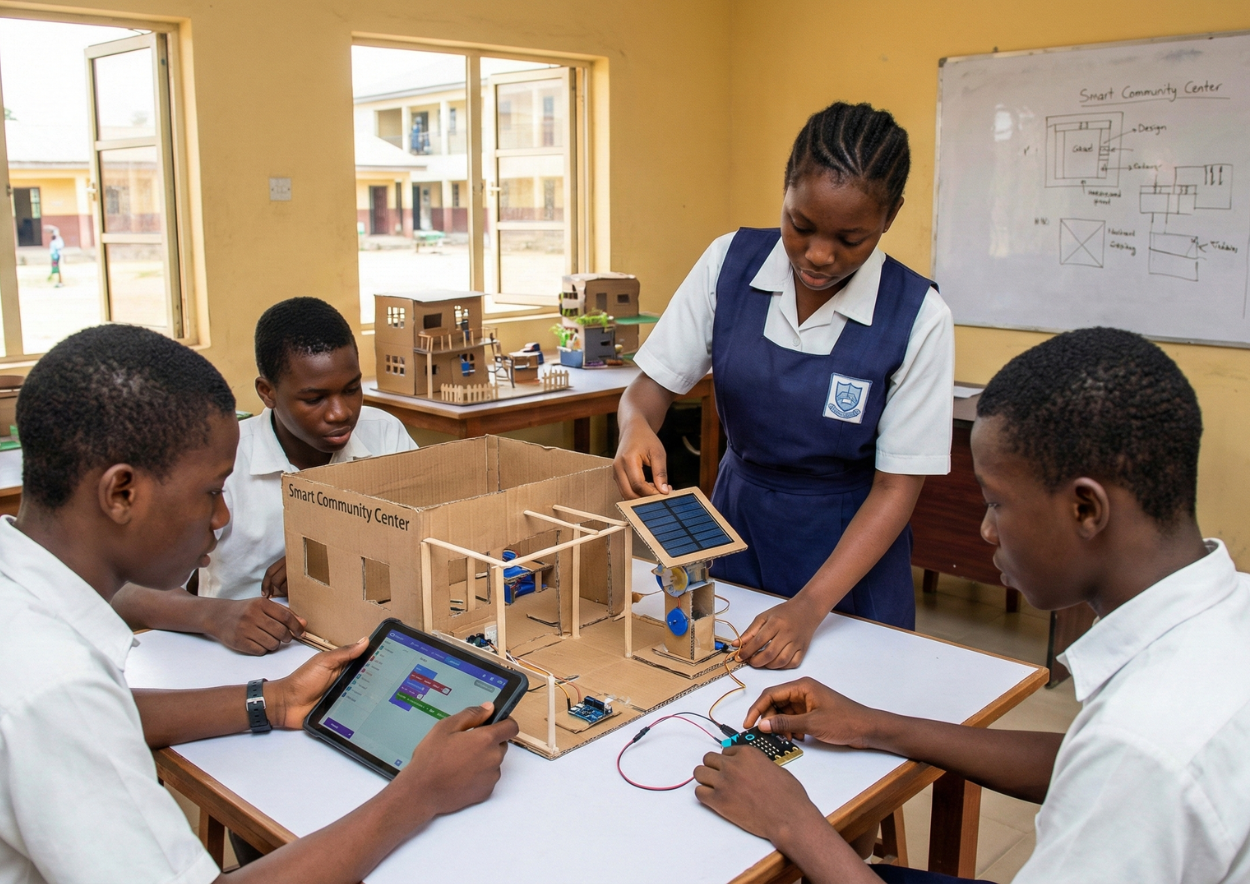
When a student’s first circuit finally flickers to life, the reaction is universal. Whether in a high-tech lab in São Paulo or a solar-powered classroom in a rural village, that moment of “It worked!” is the spark of a future engineer.
As a specialist who has spent fifteen years observing the transformation of thousands of school leaders, I know that these “small wins” are the true engine of school excellence. However, for technology to be truly transformative in our context, it must move beyond the screen and into the heart of the community. This is where Instructional Leadership meets the classroom floor. A head of school who acts as a “Lead Learner” creates a schedule and culture in which teachers can move from instructional compliance to purpose-driven, empathetic design.
What is STEAM?
In this unit, we utilize a STEAM framework. This stands for Science, Technology, Engineering, Arts, and Mathematics. While the technical subjects provide the “how,” the Arts provide the “why.” By including the Arts, we teach students to use design thinking and empathy to ensure their technical solutions actually solve human problems.
The African Design Cycle: From Brainstorm to Impact
For our teachers, innovation is often born of necessity. We use an adapted six-phase design cycle: brainstorm, define, make, test, reflect, and transfer. In a classroom where resources may be limited, this cycle encourages students to be co-authors of their learning, turning “scarcity” into a creative constraint.
Project 1: Light-Up Connection Cards
The first project focuses on the fundamentals of electricity through a deeply personal lens.
- The Challenge: Design a functional LED greeting card for someone important in the student’s life, such as a grandparent or a sibling.
- The African Context: If copper tape is unavailable, students can use thin strips of aluminum foil or salvaged wire from old electronics. This teaches that conductivity is a property of the material, not the brand of the kit.
- The Technical Skill: Students learn about inputs, outputs, polarity, and current flow.
- The Empathy Factor: By creating a card for a specific person, the circuit is no longer an abstract concept. It is a message of care.
Project 2: Interactive Awareness Posters
In many of our schools, sustainability is not just a “theme” for Earth Week; it is a daily reality involving water conservation and energy management.
- The Challenge: Create interactive posters that promote better habits, such as “Switch off the fan when you leave.”
- The Tool: Using a micro:bit or a low-cost microcontroller, students program sensors to respond to motion or light.
- The African Context: These posters are not just for display. They are installed in public areas of the school to solve real-world “energy leaks.”
- The Technical Skill: This introduces coding logic through MakeCode, a free platform that can be used offline to accommodate inconsistent internet access.
Project 3: Smart Community Prototypes
The final project synthesizes all previous skills into the design of a “Smart House” or “Smart Community Center.”
- The Challenge: Design a prototype that uses automation to save energy or improve living conditions.
- The Tool: Students use Tinkercad (a free 3D modeling tool) to plan their structures before building physical models out of cardboard and balsa wood.
- The African Context: Instead of generic “Smart Homes,” encourage students to design for our specific climate. They might prototype automated ventilation systems that trigger when a room gets too hot or a “Smart Solar” tracker that follows the sun.
- The Technical Skill: Students can even experiment with Google Teachable Machine, a free, no-code AI tool, to help their prototypes “recognize” when a person enters a room or when a plant needs water.
The Specialist’s Verdict: Leadership as the Facilitator
As an educator, your role is to guide the “make and test” phases. As a school leader, your role is to ensure the “reflection and transfer” phases happen. When a Principal allows a teacher to dedicate four weeks to this sequence, they are signaling that Academic Velocity is more important than “covering the syllabus.”
By the time these students leave your school, they will not just be looking for the most profitable job. They will be the architects of a more inclusive, sustainable Africa. They will know that the smartest person in the room is not a person at all: it is the room itself.
Ifeanyi Enukorah, PhD

