

 Tech & Tools Desk
Naira And Stock Market Decline Following Trump’s Military Warning
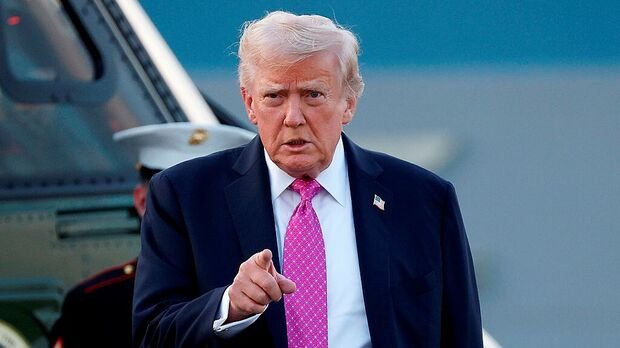
Nigeria’s financial markets opened November 2025 on a negative note as both the naira and equities weakened sharply following remarks by U.S. President Donald Trump, who threatened possible military action against Nigeria over alleged cases of religious persecution.
According to data from the Central Bank of Nigeria, the naira, which had earlier reached a 2025 high of ₦1,421.73/$, fell to ₦1,436.34/$ on Monday — a 1.03% decline representing a ₦14.61 loss in one day. At the parallel market, the exchange rate further slipped to ₦1,455/$ amid heightened investor anxiety and increased forex demand.
The drop followed a tense weekend after Trump, in a post on his Truth Social platform, described Nigeria as a “country of particular concern” and directed the U.S. Department of War to prepare for “possible action” if alleged attacks on Christians persisted. His comments, which referred to what he called a “Christian genocide” in Nigeria, stirred global debate and raised fears over potential diplomatic and economic fallout for Africa’s largest economy.
The statement quickly reverberated across Nigeria’s financial sector. At the Nigerian Exchange Limited, bearish sentiment returned as the All-Share Index fell by 0.25% to close at 153,739.11 points, cutting year-to-date gains to 49.37%. Market capitalisation dropped by ₦245.88 billion to ₦97.58 trillion.
The decline was driven mainly by losses in Aradel Holdings (-9.21%) and Access Corporation (-3.07%). Overall investor mood remained subdued, with 38 stocks declining against 19 gainers. Union Dicon topped the gainers’ list (+9.93%), while Honeywell Flour Mills led the losers (-10.00%).
Trading activity slowed significantly, with total volume and value traded falling by 87.94% and 44.64%, respectively, to 627.5 million units valued at ₦25 billion. United Bank for Africa led the trading session with 136.8 million units (21.8% of total volume) worth ₦5.5 billion (22.2% of total value). Sector performance was mixed — Oil & Gas (-3.94%), Commodities (-1.85%), Insurance (-1.48%), and Banking (-0.22%) all recorded losses, while Consumer Goods gained 0.49%. The Industrial sector closed unchanged.
In the bond market, Cowry Assets Management reported a dip in investor appetite for Nigeria’s Eurobonds, with average yields rising by five basis points to 7.70%. The firm attributed this to global risk aversion, macroeconomic uncertainty, and geopolitical tension. Bloomberg data also showed Nigeria’s dollar-denominated bonds as the worst performers among emerging markets, with the 2047 maturity dropping 0.6 cents to 88.26 cents on the dollar before trimming some losses later in the day.
Despite the sharp downturn, some analysts believe the effect may be temporary. Tilewa Adebajo, CEO of CFG Advisory, noted that “the market’s reaction appears to be a short-term shock,” adding that recent improvements, such as Nigeria’s removal from the FATF Grey List, still point to long-term economic strength.
However, Dr. Musa Yusuf, CEO of the Centre for the Promotion of Private Enterprise, warned that Trump’s remarks could severely damage investor confidence. “The U.S. President’s threat of military intervention is unnecessary and economically harmful,” he said. “Such statements raise risk perception, unsettle investors, and undermine confidence in Nigeria’s economy.”
Yusuf stressed that Nigeria should continue to strengthen internal security and governance, while ensuring that engagement with foreign powers remains “collaborative, not coercive.” He cautioned that unilateral military action “would destabilise the economy, threaten regional peace, and worsen humanitarian challenges,” urging diplomacy and mutual respect for sovereignty instead.
Analysts say that sustained market stability will depend on Nigeria’s diplomatic response, clarity on U.S. policy, and consistent macroeconomic management from the Federal Government and the Central Bank.

