

 Edupreneur Editorial Team
The Critical Thinker’s Toolkit: How Scientists Approach Research and Discovery

What is the Critical Thinking Toolkit?
Imagine a world where a simple mold could revolutionize medicine. That’s exactly what happened when Alexander Fleming noticed a bacteria-killing mold in his petri dish, leading to the discovery of penicillin. This breakthrough wasn’t just luck; it was the result of applying a powerful set of tools known as the critical thinking toolkit. This toolkit, essential for scientists, is a method of approaching problems with logic, skepticism, and a relentless curiosity. It includes core components like careful observation, forming testable hypotheses, conducting experiments, analyzing data, and subjecting findings to peer review. But this toolkit isn’t exclusive to lab coats; it’s a valuable asset for anyone navigating the complexities of modern life.
The Tools in Action:
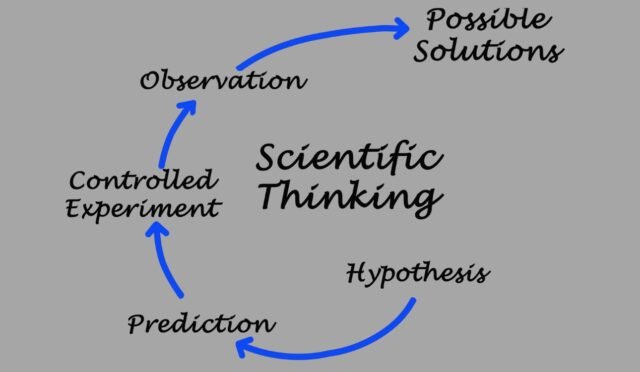
- Observation and Questioning: Scientists are keen observers, noticing patterns and anomalies that others might miss. Fleming, for example, didn’t just discard the contaminated petri dish; he asked, “Why did this mold kill the bacteria?” This questioning is the seed of scientific inquiry.
- Hypothesis Formation: Once a question is posed, scientists form a hypothesis, a testable explanation. For instance, when astronomers observed unusual gravitational effects in galaxies, they hypothesized the existence of dark matter. This wasn’t just a wild guess; it was a logical explanation based on observed phenomena.
- Experimentation and Data Analysis: To test hypotheses, scientists design controlled experiments. Clinical trials for new drugs are a prime example, meticulously designed to isolate the effects of the medication. The resulting data is then rigorously analyzed to draw conclusions.
- Peer Review and Communication: Before findings are accepted, they undergo peer review, where other scientists scrutinize the research for flaws or biases. This process ensures rigor and helps to validate discoveries. Then the findings must be communicated clearly, in order for other scientists to replicate the results.
- Embracing Uncertainty and Revision: Science is not about absolute truths. Our understanding of the universe is constantly evolving, as evidenced by the changing models of our solar system. Scientists embrace uncertainty and are willing to revise their hypotheses based on new evidence.
Applying the Toolkit in Everyday Life:
The scientific method isn’t confined to laboratories. We use it daily, often without realizing it. When evaluating news sources, we ask: “Who is the source? What evidence do they provide?” When making purchasing decisions, we compare products and analyze reviews. The critical thinking toolkit helps us navigate a world saturated with information, enabling us to make informed choices.
Conclusion:
In a world filled with information, the ability to think critically is more valuable than ever. By adopting the scientist’s approach, observing, questioning, and testing, we can become more discerning consumers of information and more effective problem-solvers. So, start using your critical thinking toolkit today and unlock your potential for discovery.

