

 Lifestyle & Wellness Desk
Trump Oversees Thai–Cambodia ‘Peace Deal’ — But What Does It Really Mean?
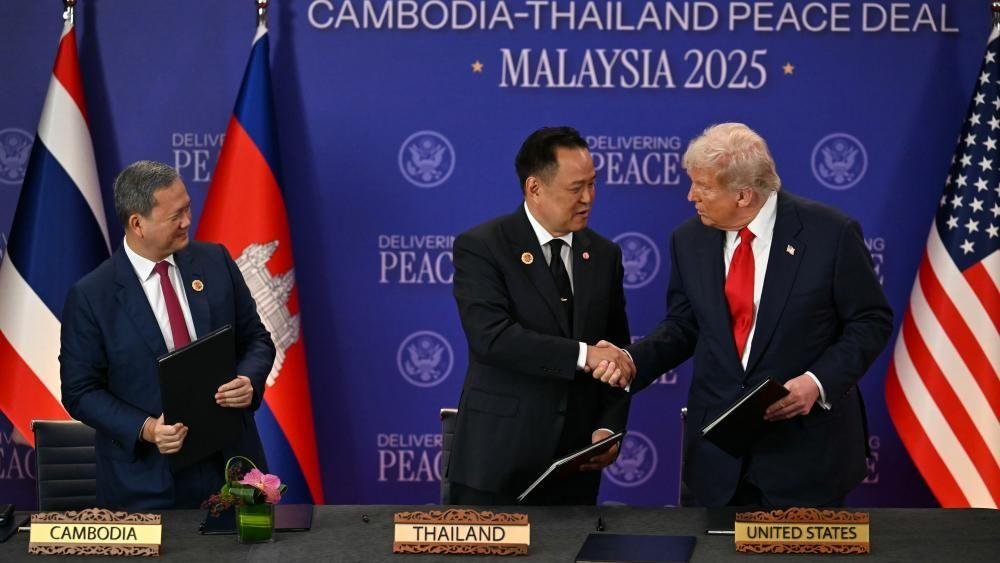
As expected, the spotlight in Kuala Lumpur was firmly on U.S. President Donald Trump.
Standing head and shoulders above the other delegates, Trump dominated the ceremony where Thailand and Cambodia signed what he has branded the Kuala Lumpur Peace Accord. His speech was the longest, his claims the boldest and his tone, typically triumphant.
“This is a momentous day for Southeast Asia,” Trump declared. “A monumental step.”
He praised the two somewhat reserved prime ministers as “historic figures” and recounted how he became involved in mediating their border dispute while visiting his Turnberry golf course in Scotland last July.
“I said this is much more important than a round of golf,” he recalled. “I could have had a lot of fun, but this is much more fun saving people and saving countries.”
The ceremony was reportedly held at Trump’s request, as a condition for his attendance at the annual Association of Southeast Asian Nations (ASEAN) summit an event previous U.S. presidents have attended only intermittently. Trump used the moment to bolster his image as a global peacemaker.
“In eight months, my administration has ended eight wars there’s never been anything like that,” he said. “We’re averaging one a month. I shouldn’t say it’s a hobby, because it’s serious, but it’s something I’m good at and something I love to do.”
But beyond the theatrics, questions remain over what the “peace accord” actually achieves.
Both Thailand and Cambodia had already agreed to a ceasefire in July a truce that Trump’s administration helped accelerate. The new agreement adds several practical measures: the withdrawal of heavy weapons from the border, the deployment of an interim observer team, a joint task force to tackle scam centres, and a plan to replace missing boundary markers. It also introduces a new landmine-clearing procedure.
Diplomats describe the accord as modest but welcome progress. Some Thai officials say Trump’s personal involvement could help sustain the fragile peace.
Still, the long-standing border dispute rooted in decades of territorial claims remains unresolved and could easily resurface.
For all the fanfare, the Kuala Lumpur signing may prove less a historic breakthrough than a brief pause in a much older conflict.

