Author: admin

admin3 December 2024
Vietnamese-Tycoon-Loses-Appeal-Against-Death-Sentence-for-Massive-Bank-Fraud-1280x744.jpg

4min57430
Vietnamese property tycoon Truong My Lan has lost her appeal against a death sentence for orchestrating one of the world’s largest banking frauds. The 68-year-old businesswoman now faces the dire prospect of execution, though there is a narrow path to commutation if she can repay a substantial portion of the funds she is accused of embezzling. In a rare and high-profile case, Truong My Lan was convicted earlier this year for masterminding a $44 billion fraud scheme over a period of more than a decade. Authorities say the tycoon secretly controlled Saigon Commercial Bank, Vietnam’s fifth- largest lender, using a complex network of shell companies to siphon off loans and funds from the bank. Of the total sum involved, $27 billion was misappropriated, while $12 billion was determined to have been embezzled, the most serious financial crime in Vietnam, for which she received a death sentence. The case is extraordinary not only because of the enormous scale of the crime, but also because Truong My Lan is one of the very few women in Vietnam to be sentenced to death for a white-collar crime. The court’s decision shocked many and underscored the country’s tough stance on financial crimes. A Ray of Hope: Possible Commutation if Funds Are Repaid Despite the verdict, the court’s ruling left the door open for a potential reduction in Truong My Lan’s sentence. Under Vietnamese law, if she can repay 75% of the $12 billion she is accused of embezzling, her death sentence could be commuted to life imprisonment. This amounts to a staggering $9 billion, a sum that could save her life. Though the appeal was rejected, the tycoon still has a chance to avoid execution if she manages to meet the repayment condition. If she fails to do so, she faces the grim prospect of death by execution. Her legal team has indicated that they plan to continue exploring options, including petitioning for a presidential pardon, which could offer a last- minute reprieve. A Changed Tone in Court During her initial trial, Truong My Lan presented herself as defiant, showing little remorse for her actions. However, her tone shifted significantly during recent appeal hearings, where she appeared more contrite and apologetic. She expressed deep embarrassment for the financial burden she had placed on the state and reiterated that her sole focus was on repaying the money she had taken. “I am ashamed of what I have done. All I want is to return what I owe and make amends,” she said in court. Her change of heart, however, did not sway the court, which upheld the original sentence. Impact on Vietnam’s Financial Landscape The case has sent shockwaves through Vietnam’s business and banking sectors, as well as the wider public. The immense scale of the fraud has raised questions about governance and regulatory oversight within the banking system. It has also sparked discussions about the severity of financial crime punishments in the country. As Truong My Lan’s legal battle continues, all eyes will be on whether she can find a way to repay the massive sum required to save her life, or if this case will end in what would be one of the most high-profile executions in Vietnam’s history.

admin3 December 2024
Nigeria-Begins-Malaria-Vaccine-Rollout-in-Bid-to-Combat-Global-Leading-Cause-of-Death-1280x744.jpg

4min21330
In a significant step toward addressing one of the world’s most devastating diseases, Nigeria has begun rolling out a malaria vaccine for the first time in its history. The vaccine, R21/Matrix-M, is being introduced to children aged five to 15 months, marking a pivotal moment in the nation’s fight against malaria. With Nigeria accounting for nearly a third of all malaria-related deaths globally, this new vaccination campaign represents a critical effort to reduce the country’s staggering death toll from the disease. Malaria remains the leading cause of death in the country, contributing to thousands of fatalities each year, especially among young children. A Breakthrough Vaccine with Promising Results The   R21/Matrix-M   malaria   vaccine,   developed   by   the   Jenner   Institute   at   Oxford University, is the second malaria vaccine to be approved by the World Health Organization (WHO). Researchers have reported that it is 75% effective in preventing malaria, a significant advancement in the fight against the disease. However, health experts caution that the vaccine should be used in combination with other malaria prevention tools, such as insecticide-treated mosquito nets and environmental measures to control mosquito populations. The vaccination process involves three doses given four weeks apart, followed by a booster shot administered one year after the initial doses. This regimen aims to provide long-term protection and reduce malaria transmission in high-risk areas. Rollout Targets and Early Progress The vaccine rollout in Nigeria has already begun in the northern state of Kebbi, with local health authorities targeting 595,000 children in the first phase of the program. Junaidu Haliru Gwandu, the Director of Immunisation and Disease Control at the Kebbi State Primary Healthcare Development Agency, emphasized the state’s commitment to reaching this ambitious target to ensure as many children as possible benefit from the vaccine. “The first phase of the rollout in Kebbi aims to vaccinate 595,000 children, and we are optimistic that this will significantly reduce malaria cases in the state,” Gwandu said. Nigeria is not alone in its adoption of the R21/Matrix-M vaccine. Earlier this year, Ivory Coast and the Democratic Republic of Congo also began using the vaccine as part of their malaria control efforts. These countries are hopeful that the vaccine, when combined with other preventive measures, will help lower the number of malaria-related deaths in the region. A Hopeful Step Toward a Malaria-Free Africa Dr. Walter Mulombo, the WHO Representative in Nigeria, expressed confidence that the new vaccine would play a vital role in achieving a malaria-free Africa. “We are confident that this vaccine, in combination with other preventive measures, will drastically reduce the burden of malaria in Nigeria and help us move closer to achieving the goal of a malaria-free Africa,” Dr. Mulombo said. Despite the promise of the vaccine, experts continue to stress the importance of maintaining a comprehensive approach to malaria prevention, including widespread distribution of insecticide-treated nets, effective treatment options, and strong public health education campaigns. As Nigeria moves forward with its malaria vaccine rollout, the country remains hopeful that this new tool, combined with ongoing preventive measures, will lead to a sharp decline in malaria cases and deaths, improving the overall health and well-being of its population.

admin3 December 2024
Tax-Reform-Bill-Sparks-National-Debate-Northern-Leaders-Express-Concerns-Over-Regional-Disparities-1280x744.jpg

6min9350
The Federal Government’s proposed tax reform bill, championed by President Bola Tinubu, has ignited a fierce national debate. With sweeping changes to the distribution of tax revenue, the bill has raised concerns among influential northern leaders, who fear it could worsen regional inequalities. The bill, which is currently under scrutiny in the National Assembly, seeks to adjust the allocation of Value Added Tax (VAT) among the three tiers of government. Under the previous allocation system, the Federal Government received 15% of the tax revenue, the state governments were allocated 50%, and the local governments took 35%. However, the proposed changes would reduce the federal government’s share to 10%, while increasing the state governments’ share to 55%, with local governments retaining their 35% allocation. While the reforms have been lauded by many as an opportunity to boost state revenues, particularly for wealthier states like Lagos and Rivers, the move has sparked widespread opposition in the northern region. Many northern leaders have voiced concerns that the new system could lead to greater financial disparities between the regions, with states in the north fearing a reduction in their share of the nation’s tax revenue. Northern Leaders Raise Alarm Aminu Tambuwal, the Governor of Sokoto State, is one of the most vocal critics of the tax reform bill. Tambuwal expressed his belief that this was not the right time for any tax increase, particularly given the economic hardships Nigerians are facing. “I believe this is a wrong time for any upward review of either VAT or any form of tax,” he said. “The time is inauspicious; the time is very wrong. Already, we are facing hardship as occasioned by the devaluation of the naira and removal of fuel subsidy that was done by this regime; I believe we should focus on managing the hardship and see how we can bring our people out of hardship.” Tambuwal’s remarks reflect the sentiment of many northern leaders who are worried that the new VAT distribution will disproportionately benefit wealthier southern states, exacerbating existing economic disparities between the regions. Presidency Responds to Concerns In response to the growing criticism, the Presidency issued a statement on Monday, attempting to allay fears over the potential negative impact of the reform on northern states. Special Adviser to the President on Information and Strategy, Mr. Bayo Onanuga, addressed the concerns in a statement, insisting that the proposed tax reform will not unfairly benefit states like Lagos and Rivers at the expense of the northern regions. Onanuga also clarified that the changes in funding for agencies such as the Tertiary Education Trust Fund (TETFUND), the National Agency for Science and Technology Infrastructure (NASENI), and the National Information Technology Development Agency (NITDA) should not be seen as efforts to scrap these agencies. Instead, the reform aims to streamline the funding mechanisms, ensuring that these institutions continue to function without harming the economic stability of any region. “No part of the tax reform bills recommends scrapping TETFUND, NASENI, and NITDA. No provision will impoverish the North,” Onanuga stated. “The aim of the reform is to ensure a more equitable distribution of tax revenue across all states, taking into account the varying economic capacities of different regions.” A National Debate: Supporters and Critics on Social Media As the tax reform bill makes its way through the National Assembly, it has become a popular topic of debate on social media, with Nigerians expressing a wide range of opinions. While many support the reform, believing it will empower state governments to take more control over their financial destinies, others are still grappling with what the changes will mean for them. Supporters argue that increasing the share of VAT allocated to states will encourage local economic development and reduce dependency on federal allocations. On the other hand, critics, particularly from the north, have expressed concerns that the new system will exacerbate existing inequalities and leave poorer regions even further behind. Some social media users are still trying to understand the full implications of the reform, with many seeking clarification on how the new distribution model will affect their local economies. There are also fears about the potential consequences of a tax increase at a time when Nigerians are already grappling with the devaluation of the naira and the removal of fuel subsidies. Looking Ahead: A Critical Juncture for Nigeria’s Fiscal Policy As the debate rages on, one thing is clear: the proposed tax reform bill is a critical juncture in Nigeria’s fiscal policy. While the reform promises to reshape the financial landscape, it also raises important questions about equity, regional development, and the ability of the Federal Government to manage national resources in a way that benefits all Nigerians. For now, the bill remains under review in the National Assembly, with both supporters and critics hoping their voices will be heard as lawmakers decide the future of Nigeria’s tax system.

admin2 December 2024
pici-1280x720.jpg

3min29340
In a groundbreaking 30-day subathon, Kai Cenat has shattered records, attracting 728,100 subscribers and raising significant funds for a school in Nigeria. The subathon, which saw Cenat live-streaming around the clock, marked a historic milestone in the world of online content creation. A Record-Breaking Achievement Cenat’s subathon, where the stream continued as long as new subscribers joined, ended with a staggering 728,100 subscriptions, setting a new standard for online events. The 30-day marathon featured a mix of gaming, real-time interactions, and special guest appearances, drawing viewers from all over the world. Supporting Education in Nigeria As part of his commitment to using his platform for social good, Cenat pledged 20% of his earnings from the subathon to a school in Nigeria. The donation will help address critical educational needs in a country where many schools face challenges like overcrowded classrooms and limited resources. While the name of the recipient school has not been publicly disclosed, the funds are expected to enhance infrastructure, provide learning materials, and support educational programs. This initiative aligns with a growing movement among influencers who are using their platforms to make a positive impact on communities in need. A New Model for Influencer Impact Cenat’s subathon is a powerful example of how influencers can leverage their massive online followings for social change. By directly tying his success to a cause, Cenat has not only set a streaming record but also demonstrated the potential for content creators to contribute meaningfully to global issues, like education. The Ripple Effect The 728,100 subscribers who contributed to the success of Cenat’s subathon are now part of a global movement that extends beyond entertainment. The funds raised will go toward improving education for children in underserved areas of Nigeria, where access to quality education remains a challenge. Cenat’s decision to donate to a school in Nigeria reflects the growing trend of influencers who are stepping up to create social good, using their platforms to address real-world issues. As online communities continue to grow, so too does the potential for these communities to make a lasting impact.   Credit: Photo Media from YouTube CC-BY-3.0 . Available on Wikimedia Common

admin29 November 2024
Top-Universities-in-Sub-Saharan-Africa-in-2024-Progress-Challenges-and-Rising-Stars-1280x720.jpg

8min38940
Sub-Saharan Africa has been making gradual progress in improving its higher education systems, and university rankings are often a reflection of the efforts made to enhance the quality of education, research, and global visibility. However, universities in the region still face several challenges, including limited funding, political instability, and issues with infrastructure. For 2024, several key trends have emerged in the rankings of universities in Sub- Saharan Africa. The QS World University Rankings 2024 and Times Higher Education (THE) Rankings 2024 are two of the most widely cited, and Sub-Saharan Africa’s institutions have had some representation, though not as high as in other parts of the world. Key Developments in Sub-Saharan Africa’s University Rankings 2024 Leading Universities in the Region Several institutions in Sub-Saharan Africa continue to dominate the regional rankings, although many still lag behind their global counterparts in terms of international recognition and academic reputation. University of Cape Town (UCT), South Africa, has maintained its position as the highest-ranked university in Sub-Saharan Africa. UCT remains a top contender in global rankings, appearing in the top 200 of the QS World University Rankings for 2024. It is particularly well-regarded for its research output, diverse student body, and international collaborations. University of the Witwatersrand (Wits), also in South Africa, is another strong performer in global rankings, continuing to secure a place in the top 300 of the QS Rankings. Wits University is known for its innovation in education and research, particularly in the fields of engineering, health sciences, and social sciences. Stellenbosch University, another South African institution, also made strides in global rankings for 2024, reflecting its efforts to improve academic quality, research, and global partnerships. Kenya’s University of Nairobi is a standout in East Africa, consistently ranking among the top universities in the region. It is recognized for its engineering, agriculture, and social science programs. Sub-Saharan Africa has been making gradual progress in improving its higher education systems, and university rankings are often a reflection of the efforts made to enhance the quality of education, research, and global visibility. However, universities in the region still face several challenges, including limited funding, political instability, and issues with infrastructure. For 2024, several key trends have emerged in the rankings of universities in Sub- Saharan Africa. The QS World University Rankings 2024 and Times Higher Education (THE) Rankings 2024 are two of the most widely cited, and Sub-Saharan Africa’s institutions have had some representation, though not as high as in other parts of the world. 2.   University of Cape Town: A Continued Regional Leader UCT has long been considered the leading university in Sub-Saharan Africa. In QS World University Rankings 2024, it was ranked #1,000-1,100 globally and is consistently in the top 200 in various subject rankings. It excels in areas such as law, education, and engineering. UCT has also been lauded for its high level of research productivity, international diversity, and commitment to producing graduates who can address Africa’s socio-economic challenges. 3.   South Africa’s Dominance in the Rankings South Africa continues to dominate the Sub-Saharan African higher education scene, with multiple universities ranked within the top 500 globally in the QS and THE rankings. Despite challenges related to underfunding and political tensions, South African universities, such as University of Pretoria, University of KwaZulu- Natal, and North-West University, continue to show resilience and growth in international rankings. 4.   Nigerian Universities: A Growing Presence In West Africa, University of Lagos (UNILAG) is the highest-ranked university in Nigeria, and its global standing is slowly improving. However, the country still faces challenges related to funding and infrastructure, which impacts the performance of many of its universities in global rankings. 5.   Regional Rankings: An Expanding Presence from East and West Africa Kenya: The University of Nairobi continues to be one of East Africa’s best- performing universities, securing its place in the lower half of global rankings. It has maintained its reputation for offering strong science, engineering, and health programs, while also expanding its research output. Nigeria: In addition to the University of Lagos, other institutions such as Obafemi Awolowo University and Ahmadu Bello University in Nigeria continue to appear in regional rankings, though they struggle to break into the top global tier due to challenges around funding, resources, and research output. Ghana: The University of Ghana has been climbing steadily in the rankings and is becoming one of the leading universities in West Africa, particularly known for its social sciences and medicine programs. Uganda: The Makerere University is another East African university that has made progress in rankings, particularly in the education and agriculture sectors. Challenges Faced by Sub-Saharan African Universities Funding and Resources: A lack of sufficient funding for universities remains a significant hurdle, limiting their ability to invest in infrastructure, research, and faculty development. Many universities in the region continue to rely heavily on government funding, which is often insufficient. Political Instability: In some parts of Sub-Saharan Africa, political instability, violence, and conflict continue to hinder the development of higher education systems. Universities in countries such as South Sudan, Somalia, and Democratic Republic of Congo face significant challenges related to security and governance. Brain Drain: The migration of skilled professionals and academics to other regions, particularly Europe and North America, continues to impact universities in Sub-Saharan Africa. This “brain drain” limits the potential for academic growth and the transfer of knowledge within the region. Lack of Global Recognition: While many Sub-Saharan African universities are improving, they still face challenges in achieving global recognition for their academic programs. This is largely due to limited research funding, lack of international collaborations, and an emphasis on undergraduate education rather than graduate research. Conclusion: The Road Ahead for Sub-Saharan African Universities The 2024 university rankings highlight the steady progress of Sub-Saharan Africa’s universities, particularly in countries like South Africa, Kenya, and Nigeria. However, challenges remain, especially regarding funding, political stability, and global recognition. Institutions in the region must continue to innovate, improve research capabilities, and foster international collaborations to secure a stronger presence in global rankings in


admin29 November 2024
Former-Chinese-State-Media-Journalist-Sentenced-to-Seven-Years-in-Prison-for-Espionage-1280x720.jpg

5min31350
Dong Yuyu, a former senior journalist with China’s state-owned Guangming Daily, has been sentenced to seven years in prison for espionage. The 62-year-old, who had been detained since 2022, was convicted after a trial that has drawn international attention and criticism from rights groups. Background and Arrest Dong was arrested in Beijing while dining with a Japanese diplomat in 2022. His detention occurred amid his active involvement in academic and journalistic circles, both  in  the  United  States  and  Japan,  where  he  was  known  for  his  extensive interactions with foreign diplomats. At the time of his arrest, Dong had been a senior staff member of Guangming Daily, one of the five major newspapers officially tied to the Chinese Communist Party (CCP). The court hearing on Friday, where Dong was sentenced, took place under tight security, with Reuters reporting that journalists were barred from attending and diplomats were not allowed access. The proceedings were seen as part of a broader trend where the Chinese government limits media access to sensitive trials, especially those involving high-profile individuals. Political and Journalistic Background Dong’s career has spanned several decades, during which he became known for his pro-reform stance within China’s tightly controlled media environment. A prominent figure in the 1989 Tiananmen Square protests, Dong was one of the many students advocating for political reform and democracy. Although he was sentenced to hard labor at the time, he was allowed to retain his position at Guangming Daily. Over the years, he rose through the ranks, eventually becoming the deputy head of the editorial department, where he continued to be a vocal proponent of reformist ideas. Dong’s connections to Western media are also significant. In 2007, he was selected as a Nieman Fellow at Harvard University, a prestigious program for journalists, and he later contributed articles to major international publications such as the New York  Times.  Dong  had  also  served  as  a  visiting  professor  at  several  Japanese universities, further establishing his international academic and journalistic reputation. Trial and Conviction Dong’s trial, which concluded in July 2023, was shrouded in secrecy. Despite the trial’s completion, he remained in detention for months without a verdict, and his family was denied access to him during this period. The US National Press Club pointed out that the timing of Dong’s sentencing, on Thanksgiving night in the United States, was likely a deliberate effort by the Chinese government to minimize international scrutiny during a time when the global public’s attention is diverted elsewhere. Reactions and Criticism Rights organizations and advocates have condemned Dong’s conviction, describing it as politically motivated. Human rights groups have expressed concerns about China’s increasing crackdown on press freedom and its ongoing persecution of dissenting voices. Dong’s long history of involvement in pro-reform activism and his efforts to challenge China’s media landscape have made him a target of the government, critics argue. In response to the sentencing, several prominent organizations, including Reporters Without Borders and the Committee to Protect Journalists, have called for Dong’s immediate release, labeling the charges against him as baseless. Legacy and International Impact Dong’s case is not just about one individual; it is a symbol of the broader repression faced by journalists and activists within China. Despite government efforts to control information and suppress dissent, figures like Dong have remained steadfast in their commitment to independent journalism and free expression. His sentencing adds to the growing list of individuals in China facing persecution for speaking out against government policies or attempting to bring transparency to state affairs. As China’s crackdown on dissidents intensifies, the international community will likely continue to scrutinize the country’s treatment of journalists and human rights activists. The case of Dong Yuyu serves as a reminder of the personal and professional risks that come with challenging the Chinese state’s control over media and political discourse.

admin29 November 2024
Australia-Passes-Groundbreaking-Social-Media-Ban-for-Children-Under-16-Tech-Companies-React-1280x720.jpg

5min31680
In a world-first move, Australia’s parliament has passed a law banning social media use for children under the age of 16, putting global tech companies on notice. The legislation, which passed the Senate late Thursday, will require tech platforms to implement strict age verification measures or face hefty fines. The new law mandates that social media giants such as TikTok, Snapchat, Facebook, Instagram, Reddit, and X (formerly Twitter) take “reasonable steps” to prevent minors from accessing their services. If these platforms fail to comply, they could face fines as high as 50 million Australian dollars ($32 million). While the law is expected to target the most widely used platforms, experts predict that the list could expand in the future. A Rapid Legislative Process The bill was introduced and debated within a week, underscoring the urgency surrounding child safety online. Despite the rushed parliamentary process, the law gained significant traction after months of public debate about the harmful effects of social media on children’s mental health. Supporters argue that the ban is necessary to protect young people from online dangers, including cyberbullying, exposure to inappropriate content, and the mental health impacts of social media. Polling data reveals that a majority of Australians back the move, with a recent survey showing 77% of respondents in favor of the under-16 ban. Tech Companies’ Concerns and Adaptations Tech companies are now grappling with the implications of the law and how it will be enforced. Snap Inc., which owns Snapchat, a platform widely used by children, has expressed concerns over the lack of clarity around the law’s implementation. The company, which has been advocating for “device-level age verification” to streamline the process, is seeking further guidance from the government. “We support efforts to keep children safe, but there are still many unanswered questions about how the law will be implemented across various devices and platforms,” said a spokesperson for Snap Inc. Meanwhile, X, the social media platform owned by Elon Musk, downplayed the use of its service among minors but voiced concerns about the potential impact on freedom of expression. In its submission to the parliamentary inquiry, X stated that while it is “not widely used by minors,” it is still concerned that the legislation could restrict young people’s access to certain forms of speech and expression. Potential Risks and Criticism Despite the widespread support for the law, some experts have raised concerns about its potential consequences. Critics argue that the ban may drive children to use unregulated platforms, where they may be exposed to more harmful content. There is also concern that minors who evade the restrictions may be less likely to report issues like cyberbullying or inappropriate content to adults. “While the intent is to protect children, this could inadvertently push them into more dangerous online spaces that offer less oversight,” said Dr. Emily Harris, a child protection expert at the University of Sydney. What Happens Next? The government has emphasized that parents and children will not be penalized for breaching the ban. Instead, tech companies will bear the responsibility of ensuring that their platforms comply with the new regulations. The government will conduct a broad consultation before setting a date for the enforcement of the law. At that point, all accounts belonging to children under 16 will be deactivated, forcing platforms to take immediate action. For now, the law signals a new era of digital responsibility, with Australia leading the charge in safeguarding the online experience for children. As tech companies prepare for these changes, the global conversation on social media regulation and child safety is likely to intensify.

admin28 November 2024
Nigerias-Education-Minister-Announces-Bold-Reforms-to-Strengthen-STEM-and-Vocational-Education-1280x720.jpg

4min26690
In a move to revamp Nigeria’s education landscape, the Minister of Education, Maruf Alausa, has rolled out a new plan aimed at significantly boosting STEM (Science, Technology, Engineering, and Mathematics) education and expanding vocational training across the nation. Speaking at the launch of the Education Sector Renewal Initiative 2024-2027 in Abuja, Alausa outlined key reforms designed to address the country’s educational challenges and enhance the employability of Nigerian youth. The launch event, which brought together major stakeholders including representatives from UNICEF, UNESCO, the World Bank, and the European Union, underscored the government’s commitment to educational transformation and the role of global partners in achieving these ambitious goals. Strategic Focus on Skills Development and Inclusive Education: One of the primary focuses of the new policy is the integration of STEM education at all levels, alongside the expansion of Technical and Vocational Education and Training (TVET) programs. With the global job market increasingly driven by technology, Alausa emphasized that Nigeria must prepare its youth to meet the demands of emerging industries by equipping them with practical, high-demand skills. “Education is the foundation for any nation’s progress, and by prioritizing STEM and vocational training, we are empowering our students to drive innovation, economic growth, and social development,” Alausa stated. Tackling Out-of-School Children and Learning Gaps: Addressing the alarming number of out-of-school children remains a central goal for the government. Alausa unveiled a series of initiatives to integrate out-of-school children, including those from marginalized communities like the Almajiri system, into formal education. Special programs such as conditional cash transfers and school feeding initiatives will be introduced to support vulnerable children, particularly girls, and those from disadvantaged backgrounds. The Minister also stressed the importance of reducing learning poverty, a term referring to children who are enrolled in school but lack basic literacy and numeracy skills. As part of the reforms, there will be an increased emphasis on improving teaching quality, curriculum design, and educational outcomes to ensure that students are not only in school but are learning effectively. Strengthening Governance for Sustainable Change: Alausa emphasized that in order to achieve these ambitious goals, significant reforms in the governance and management of the education sector are necessary. This will involve restructuring educational institutions for greater accountability, improving oversight at both national and state levels, and ensuring better planning, resource allocation, and monitoring of educational programs. International  Collaboration  Key  to  Success:  In  his  speech,  Alausa  also highlighted the vital role of international partners and the private sector in supporting these reforms. He called for stronger partnerships with global development agencies, academic institutions, and private industries to provide the technical expertise, funding, and resources necessary to implement these changes. “Partnerships will be key to our success,” he said. “We must work with our international allies to bring world-class standards to our schools and training centers, and ensure that our students are prepared for the challenges of tomorrow’s global workforce.” Looking Ahead The Education Sector Renewal Initiative aims to equip the next generation of Nigerians with the skills needed to thrive in an increasingly complex and competitive world. With a focus on STEM education, vocational training, and inclusive policies for vulnerable groups, the government hopes to create an educational ecosystem that fosters innovation, employment, and sustainable growth.

admin28 November 2024
TETFund-Suspends-Scholarship-Scheme-After-Students-Abscond-on-Arrival-1280x720.jpg

4min13300
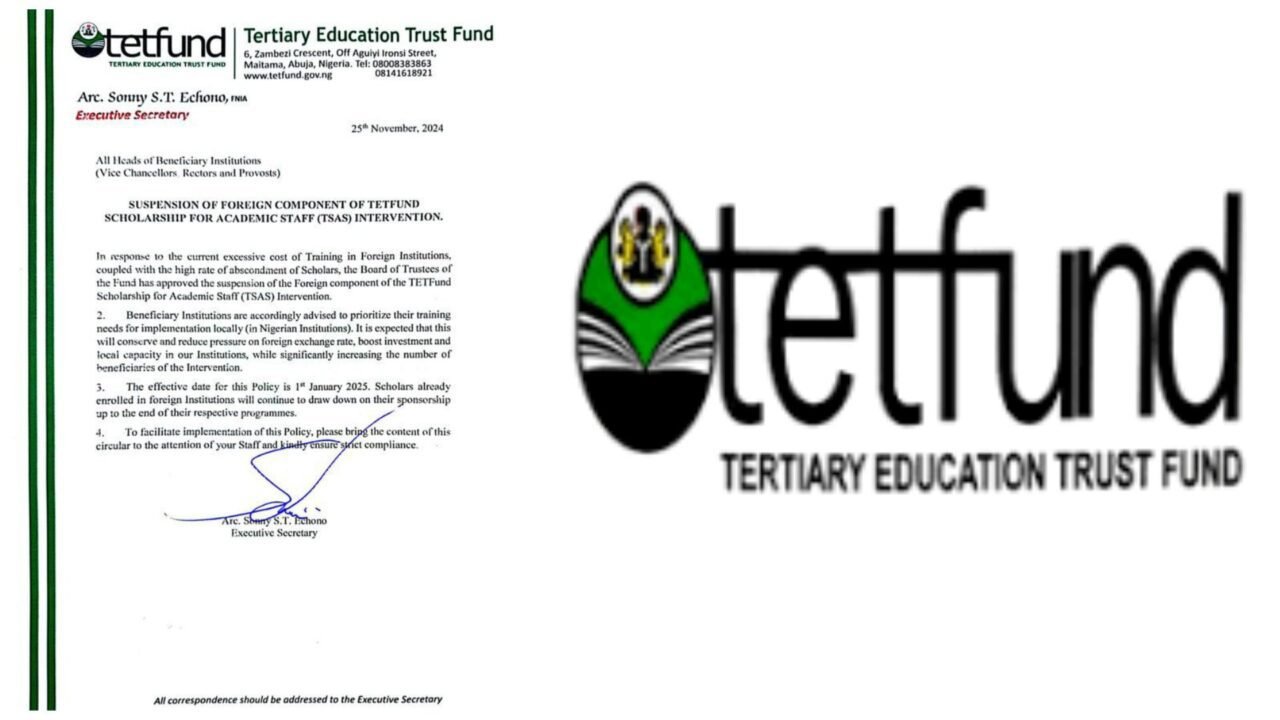
The Tertiary Education Trust Fund (TETFund) has announced the suspension of its scholarship program aimed at supporting Nigerian students pursuing higher education abroad. This decision follows troubling reports that a significant number of students who were awarded the prestigious scholarships failed to report to their assigned universities, with some absconding altogether upon arrival. The scholarship scheme, which had been hailed as a transformative opportunity for Nigerian students, covered tuition fees, travel expenses, and living stipends for those selected. Designed to empower students from various academic backgrounds, the initiative sought to expose them to international education and foster global knowledge exchange. However, the recent incidents of abscondment have thrown the future of the program into uncertainty. The Abscondment Issue According to TETFund sources, several recipients of the scholarship program failed to enroll in their respective institutions after arriving abroad. Some were unreachable by the fund’s monitoring team, raising serious concerns about the program’s effectiveness and integrity. While the exact number of students involved is still being verified, the fund has made it clear that such actions undermine the primary goal of the initiative, which is to invest in the future of Nigerian students and the country at large. “The actions of a few individuals have not only disrupted the goals of the scholarship program but have also led to significant financial and administrative challenges,” said a TETFund spokesperson. “We cannot continue to fund a program where the resources are misused or students are not fulfilling their academic commitments.” The Suspension As a result of the abscondment incidents, TETFund has decided to temporarily suspend the scholarship program while it reviews the selection, monitoring, and accountability mechanisms in place. The organization emphasized that this suspension is a necessary measure to ensure that public resources are used responsibly and that future beneficiaries are genuinely committed to pursuing their education abroad. The Impact: The suspension of the scholarship scheme has left many potential beneficiaries in limbo. For students who had qualified and were eagerly awaiting the opportunity to study abroad, the announcement has come as a disappointment. Many had worked hard to meet the scholarship’s rigorous selection criteria, and the scheme had represented a rare opportunity for them to gain an international education. However, the suspension has also sparked discussions about accountability. Stakeholders in the educational sector have voiced support for the fund’s decision, emphasizing that such programs must prioritize commitment and academic responsibility. What’s Next for TETFund? TETFund has assured the public that it is committed to restoring the scholarship program once the review is completed. The agency has stated that it will work closely with its international partners to ensure that future participants are more closely monitored and held accountable for their academic and behavioral conduct. In the meantime, TETFund has urged prospective students to remain patient and stay informed about the outcome of the review, which will likely take several months. As the situation unfolds, many will be watching closely to see what changes will be implemented to prevent such issues in the future. For now, TETFund’s suspension of the scholarship program serves as a cautionary reminder of the need for greater oversight and responsibility in managing educational initiatives that involve public funding. While the long-term effects on students’ access to international education remain uncertain, one thing is clear: accountability will be a key focus in the coming months.

admin27 November 2024
Obasanjo-Slams-Death-Rumors-Calls-Them-Fake-News-1280x720.jpg

2min15160
Former Nigerian President Olusegun Obasanjo has vehemently dismissed rumors circulating on social media about his alleged death, calling them “false and malicious.” The rumors, which have been spreading rapidly across various platforms, caused a stir among his supporters and the general public. In a statement released through his media office, Obasanjo expressed his deep disappointment over the spread of such baseless claims. “I am very much alive and in good health,” he said, urging the public to disregard the unfounded rumors. The former president also condemned the growing trend of misinformation, stressing the importance of responsible media practices in ensuring that such falsehoods do not disrupt the peace of the nation. The rumor had gained traction after a series of posts across various social media platforms falsely claimed that Obasanjo had passed away. The spread of the rumor prompted many Nigerians to share condolences, but the former president quickly reassured his followers through his official channels, confirming that he is alive and continuing his work as an elder statesman. Obasanjo, who served as Nigeria’s president from 1999 to 2007, has been a prominent figure in Nigerian politics and on the international stage, often speaking out on issues related to peace, security, and governance. His health and well-being are of significant public interest, and many Nigerians were relieved to hear his direct confirmation of his continued vitality. The former president’s office also used the opportunity to highlight the dangers of misinformation in the digital age. “We must collectively work to ensure that false news does not harm individuals, families, or the larger community,” the statement read. As the rumors continue to circulate, Obasanjo’s supporters have rallied around him, showing their unwavering loyalty and respect for his legacy. Many expressed their relief and joy upon hearing the truth, while others criticized the spread of such unverified and harmful content.