

 James Obasi
#Freennamdikanu: Protest Erupts in Abuja, Grounds Activities Across South-East States
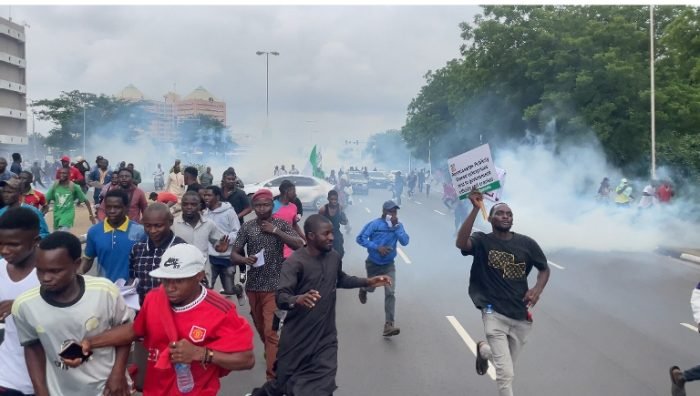
A coordinated wave of demonstrations demanding the release of the detained leader of the Indigenous People of Biafra (IPOB), Nnamdi Kanu, swept through the Federal Capital Territory and major cities across the South-East on Monday, disrupting commercial activities and grounding transportation networks.
The protest, organized by activist and former presidential candidate Omoyele Sowore, leader of the #RevolutionNow movement, triggered a massive deployment of security personnel around critical government facilities, including the Three Arms Zone — home to the Presidential Villa, National Assembly, and Supreme Court.
By early morning, heavily armed security operatives had cordoned off major access routes to the area, restricting movement and intensifying stop-and-search operations. Armoured vehicles and patrol trucks were stationed at key intersections, while federal civil servants faced temporary delays accessing ministries within the central business district.
In Abuja, protesters who converged at the Unity Fountain were dispersed by combined teams of police, soldiers, and operatives of the Department of State Services (DSS) as they attempted to march towards the Presidential Villa. The dispersal operation led to significant traffic gridlock across the capital city, especially along the Nyanya–Mararaba axis and Airport Road.
Security presence was also heightened around Eagle Square, the Federal Secretariat, and other strategic points to prevent a possible escalation.
The protest was part of renewed calls for the Federal Government to comply with existing court rulings ordering Kanu’s release. The IPOB leader, arrested and extradited from Kenya in 2021, has remained in DSS custody despite multiple court decisions granting him bail.
Supporters of Kanu have repeatedly expressed concern over his health, urging the government to allow him access to medical care. However, the Federal Government maintains that Kanu faces serious charges bordering on treasonable felony and terrorism.
Speaking on the motive behind the demonstration, Sowore said the protest aimed to highlight the government’s “blatant disregard for the rule of law,” adding that peaceful assembly is a constitutional right.
The Nigeria Police Force later defended its dispersal of protesters, stating that officers acted lawfully in enforcing a court order that restricted access to sensitive government zones, including the Presidential Villa and National Assembly. Force Public Relations Officer, Benjamin Hundeyin, clarified that only tear gas was used to control the crowd and that no live ammunition was fired.
The Nigeria Security and Civil Defence Corps (NSCDC) also condemned the demonstration, describing it as an “anti-government protest disguised as a campaign for justice.” The agency confirmed that over 50 individuals had gathered at its national headquarters, prompting the deployment of additional security operatives nationwide to protect critical infrastructure.
Across the South-East, the impact of the protest was widespread. Cities such as Enugu, Aba, Owerri, and Onitsha experienced total lockdowns, with banks, schools, and markets shut down. In Umuahia and Aba, supporters of the movement sang solidarity songs and called for Kanu’s release through peaceful dialogue.
Several Igbo socio-cultural leaders appealed to the Federal Government to resolve the issue through negotiation and reconciliation. They stressed that releasing Kanu would promote peace, unity, and national healing.
In Anambra State, residents observed a total sit-at-home, with major markets like Onitsha Main Market and Nkwo Nnewi closed. Although authorities had earlier discouraged the practice, traders and transport operators stayed indoors in solidarity. The Commissioner of Police, Ikioye Orutugu, assured residents of adequate security and reiterated the command’s commitment to maintaining peace and order.
Similar scenes were recorded in Ebonyi, where economic activities were halted despite the absence of physical marches. Major streets and markets were deserted as security personnel maintained patrols to forestall possible unrest.
In Ondo State, many Igbo traders joined the protest symbolically by shutting their shops. In Akure, commercial areas such as Arakale and Oyemekun roads were quiet, with traders saying the action was a show of solidarity for Kanu’s release.
Security agencies across the affected states maintained heavy patrols throughout the day, ensuring that the demonstrations did not degenerate into violence.

