

 Edupreneur Editorial Team
How to Teach Every Type of Learner (VARK Made Simple)

Every student learns differently. Some light up when they see diagrams, others absorb information better when they hear it out loud, while a few prefer hands-on tasks or neatly written notes. As educators, parents, or anyone guiding learning, recognizing these differences is key. That’s where the VARK model comes in; a simple yet powerful framework to help us understand and support diverse learners.
What is the VARK Model?
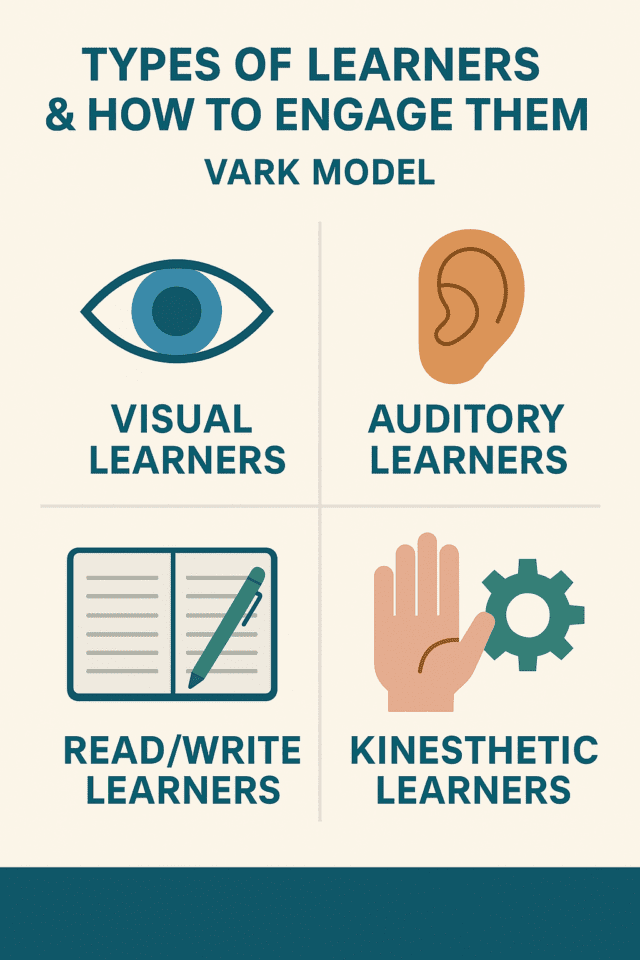
Developed by Neil Fleming, the VARK model identifies four primary types of learners based on how they prefer to receive and process information:
- Visual
- Aural (or Auditory)
- Read/Write
- Kinesthetic
Each learning style responds best to a particular method of teaching, and knowing how to engage each type can make a huge difference in learning outcomes.
1. Visual Learners
How they learn:
These learners prefer to see information in the form of diagrams, charts, symbols, color-coded notes, and spatial understanding.
Tips to engage them:
- Use infographics, flowcharts, and videos with strong visuals.
- Present key concepts with mind maps or slides.
- Encourage them to draw or sketch what they’ve learned.
Bonus: Color-coding information can help visual learners retain details faster.
2. Auditory Learners
How they learn:
They learn best through listening. Lectures, discussions, and even background music can help them process information.
Tips to engage them:
- Read instructions aloud or provide audio recordings.
- Use group discussions, podcasts, or storytelling.
- Let them “teach back” what they’ve learned verbally.
Bonus: Rhymes, mnemonics, and songs can reinforce memory.
3. Read/Write Learners
How they learn:
These learners thrive on written words. They enjoy reading texts and writing notes to understand and retain information.
Tips to engage them:
- Provide handouts, articles, and written instructions.
- Encourage journaling, note-taking, or creating study guides.
- Use lists, headings, and bullet points to organize information.
Bonus: These learners often do well with traditional classroom methods.
4. Kinesthetic Learners
How they learn:
They prefer hands-on experiences. Movement, touch, and doing are central to how they absorb knowledge.
Tips to engage them:
- Include role-plays, experiments, or physical activities.
- Use real-life examples and case studies.
- Allow movement breaks and tactile learning tools.
Bonus: Field trips, building models, or using manipulatives work well here.
Can a Learner Be More Than One Type?
Yes! Many people are multimodal, meaning they benefit from a mix of learning styles. The VARK model isn’t about boxing students into categories, but offering insight into preferences. Understanding these can help personalize teaching and make learning stick.
Why This Matters in Real Life
Imagine teaching a class of 30 students using only lectures. That might work for auditory learners, but the rest could be left behind. The VARK model reminds us to diversify how we teach and that’s where true engagement happens.
Whether you’re a teacher designing lessons, a parent helping with homework, or a student trying to study smarter, knowing these styles can improve comprehension, retention, and enjoyment of learning.
Final Thoughts
There’s no one-size-fits-all in education, and that’s the beauty of it. The VARK model gives us a simple lens to see learners more clearly and meet them where they are. When we engage students according to their learning style, we help them not just learn but to love learning as well.

